Date Log
Algorithmic Governmentality and the Construction of Political Truth
PCD Journal,
Vol 14 No 1 (2026): PCD Journal Vol. 14 No. 1 2026
Abstract
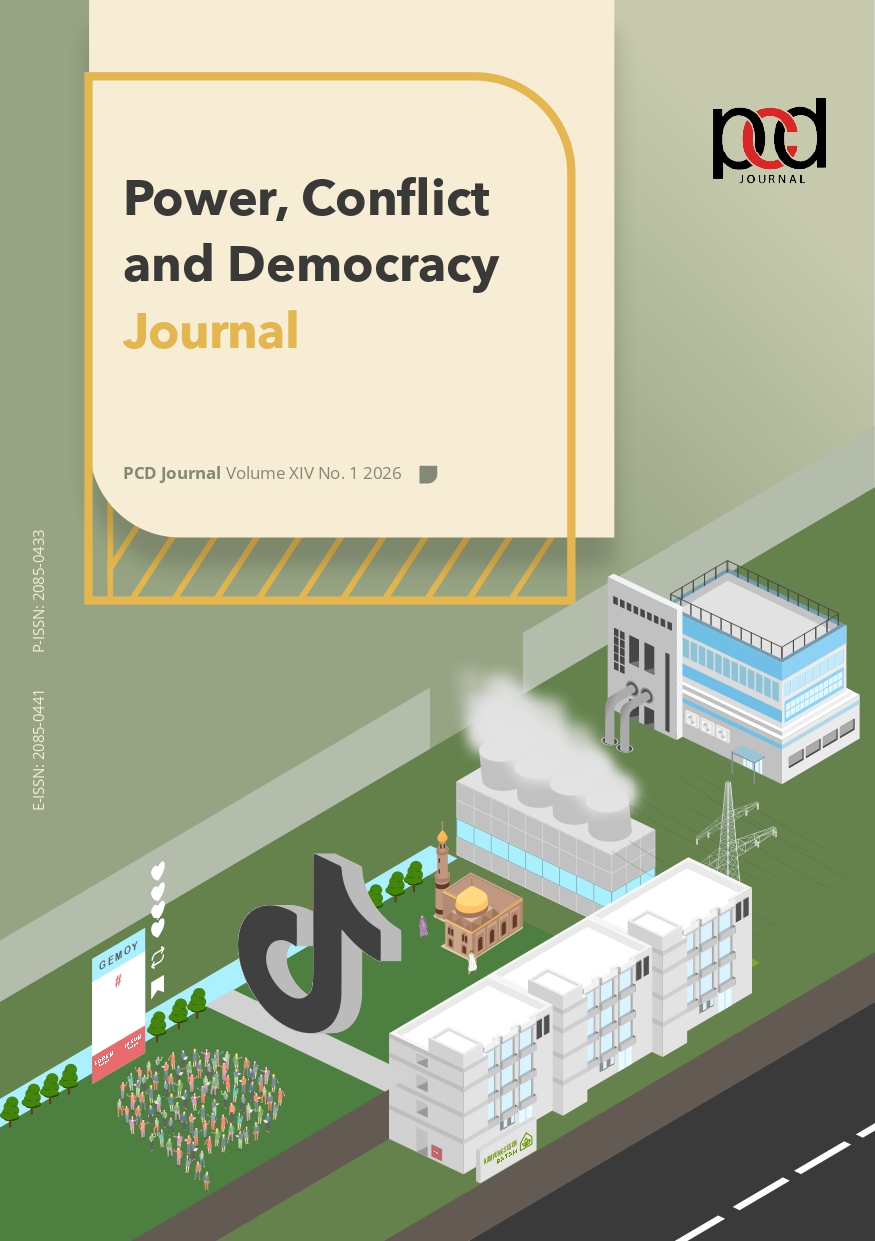
The shift in political campaigning style ahead of the 2024 election has been largely driven by technological advancements. Candidates increasingly utilised social media, particularly TikTok, to attract the attention of Gen Z and Millennial voters. This study aims to examine how the TikTok algorithm functioned as a political marketing strategy for the Prabowo–Gibran pair and to analyse the power relations embedded within their digital campaign. Employing a qualitative methodology the research uses content analysis techniques underpinned by Michel Foucault’s perspective on discourse theory. Were gathered through a literature review and observation of TikTok content. While content analysis identifies specific campaign patterns and strategies, the Foucauldian lens reveals the power relations operating within algorithmic mechanisms. The findings demonstrate that the Prabowo–Gibran campaign used the ‘gemoy’ dance, viral jingles, and AI-generated cartoons to engage young voters. Through discourse practices that shape a new ‘regime of truth’, the ‘reversal to real’ strategy successfully transformed Prabowo’s public persona from a stern military figure into a populist one. Furthermore, the power relations within Jokowi’s political network were widely disseminated via TikTok, with algorithms serving as a ‘technology of power’ that governed voter preferences and contributes to the pair’s victory.
Keywords
Download Citation
Endnote/Zotero/Mendeley (RIS)BibTeX
- Az-zahra, R. N. N., Fitrialdi, M. R., Nurjanah, E., Darmawan, M., & Firmansyah, R. (2021). Analisis Sentimen Media Sosial Tiktok dengan Metode Supervised Learning pada Algoritma Machine Learning. Buffer Informatika, 7(1), 18–25. https://doi.org/https://doi.org/10.25134/buffer.v7i1.3829
- Benkler, Y. (2006). The Wealth of Networks: How Social Production Transforms Markets and Freedom. London, UK: Yale University Press. Retrieved from https://www.jstor.org/stable/j.ctt1njknw
- Brady, W. J., Wills, J. A., Jost, J. T., Tucker, J. A., & Bavel, J. J. Van. (2017). Emotion Shapes the Diffusion of Moralized Content in Social Networks. Psychological and Cognitive Sciences, 114(28). https://doi.org/10.1073/pnas.1618923114
- Fahmi, I. (2024). Analisis TikTok Capres dan Cawapres Pilpres 2024. droneemprit.id. Retrieved from https://pers.droneemprit.id/analisis-tiktokcapres-cawapres-pilpres-2024/
- Febriana, D. & Rahman, S. (2024). Viral Politics and Platform Power: TikTok’s Role in Shaping Electoral Discourse in Southeast Asia. Communica: Jourmal of Communication, 2(1), 28–40. https://doi.org/10.61978/communica.v2i1.753
- Firmanzah. (2012). Marketing Politik: Antara Pemahaman dan Realitas. Jakarta, Indonesia: Yayasan Pustaka Obor Indonesia.
- Foucault, M. (1972). The Archaeology of Knowledge & The Discurse on Language. New York, USA: Pantheon Books.
- Foucault, M. (1977a). Discipline & Punish: The Birth of Prison. New York, USA: Vintage Books.
- Foucault, M. (1977b). Power/Knowledge: Selected Interviews and Other Writings, 1972-1977. New York, USA: Patheon Books.
- Foucault, M. (1991). The Foucault Effect: Studies in Governmentality with Two Lectures by and an Interview with Michael Foucault. Chicago: The University of Chicago Press.
- Foucault, M. (2013). Archaeology of Knowledge (2nd Edition). New York, USA: Routledge. https://doi.org/10.4324/9780203604168
- Geschke, D., Lorenz, J., & Holtz, P. (2018). The Triple-Filter Bubble: Using Agent-Based Modelling to Test a Meta-Theoretical Framework for the Emergence of Filter Bubbles and Echo Chambers. British Journal of Social Psychology, 58(1), 129–149. https://doi.org/https://doi.org/10.1111/bjso.12286
- Indikator. (2024). Exit Poll Pemilu 2024: Basis Demografi dan Perilaku Pemilih. Jakarta. Retrieved from https://indikator.co.id/wp-content/uploads/2024/02/Rilis-Exit-Poll-Pilpres-2024-Indikator.pdf
- Jalli, N., Ningtyas, I., & Setianto, Y. (2025). How TikTok’s Visual Politics Shaped Indonesia’s 2024 Election. Fulcrum: Analysis on Southeast Asia. Retrieved from https://fulcrum.sg/how-tiktoks-visual-politics-shaped-indonesias-2024-election/
- Kemp, S. (2024). Digital 2024: Indonesia. datareportal.com. Retrieved from https://datareportal.com/reports/digital-2024-indonesia
- Lubis, M. W. (2023). Perbandingan Personal Branding Anies Baswedan dan Ganjar Pranowo dalam Komunikasi Politik di Media Sosial Instagram. Journal of Politic and Government Studies, 12(3), 57–72. Retrieved from https://ejournal3.undip.ac.id/index.php/jpgs/article/view/39387
- Mendoza, M. E. H. (2022). Philippine Elections 2022: TikTok in Bongbong Marcos’ Presidential Campaign. Contemporary Southeast Asia, 44(3), 389–395. Retrieved from https://www.researchgate.net/publication/368450420_Philippine_Elections_2022_TikTok_in_Bongbong_Marcos’_Presidential_Campaign
- Moslehpour, M., Schafferer, C., Lewi, S., Kurniawati, D., Pham, V. K., & Faez, S. E. P. (2024). The Influence of Social Media Marketing on Voting Intention in Indonesia. Journal of Political Marketing, 24(4), 1–28. https://doi.org/10.1080/15377857.2024.2303509
- Muhammad, N. (2023). KPU: Pemilih Pemilu 2024 Didominasi oleh Kelompok Gen Z dan Milenial. databoks. Retrieved from https://databoks.katadata.co.id/pasar/statistik/faf64350269d0c8/kpu-pemilih-pemilu-2024-didominasi-oleh-kelompok-gen-z-dan-milenial
- Mujhid, A. (2025). Bagaimana Algoritma Membentuk Opini Publik? socs.binus.ac.id. Retrieved from https://socs.binus.ac.id/2025/11/03/bagaimana-algoritma-membentuk-opini-publik/
- Palijama, S. (2024). Tiktok and Political Campaign. Case Study Series #98. Yogyakarta, Indonesia: Center For Digital Society.
- Pariser, E. (2011). The Filter Bubble: What The Internet is Hidding From You. London, UK: The Penguin Books.
- Perdana, A. (2023, September 4). Bahaya AI di Kampanye Pemilu 2024. Tempo.co. Retrieved from https://www.tempo.co/digital/bahaya-ai-di-kampanye-pemilu-2024-821142
- Philips, W., Richardson, E. A., & Thompson, M. (2024). Exploring How the Filter Bubble Effect on Twitter Influences Political Polarization and the Mediating Role of Media Literacy. Journal of Linguistics and Communication Studies, 3(1). https://doi.org/10.56397/JLCS.2024.03.11
- Rahmawati, D. (2018). Risiko Polarisasi Algoritma Media Sosial: Kajian terhadap Kerentanan Sosial dan Ketahanan Bangsa. Jurnal Lemhannas RI, 6(1), 37–49. Retrieved from https://jurnal.lemhannas.go.id/index.php/jkl/article/view/114
- Rouvroy, A. (2020). Algorithmic Governmentality and the Death of Politics. Green European Journal, 1–5. Retrieved from https://www.greeneuropeanjournal.eu/wp-content/uploads/pdf/algorithmic-governmentality-and-the-death-of-politics.pdf
- Sakti, R. E. (2023). Media Sosial Pengaruhi Pemilih pada Pemilu 2024. Kompas.id. Retrieved from https://www.kompas.id/artikel/media-sosial-pengaruhi-pemilih-pada-pemilu-2024
- Shirky, C. (2008). Here Comes Everybody: The Power of Organizing Without Organizations. New York, USA: Pinguin Press.
- Sianipar, H., Yulianto, H., Iskandar, H. M., & Seran, A. (2025). Digital Power and the Regime of Truth: A Foucauldian Analysis of Algorithmic Journalism. Interaction: Jurnal Pendidikan Bahasa Indonesia, 12(1), 1180–1190. https://doi.org/https://doi.org/10.36232/interactionjournal.v12i1.3825
- Sahputra, T. (2023, September 20). Pemilu dan Bahaya Algoritma Digital. Detiknews.com. Retrieved from https://news.detik.com/kolom/d-6941007/pemilu-dan-bahaya-algoritma-digital
- The Infinite Agency. (2022). Top 6 Secrets About TikTok’s Algorithm You Need to Know. The Infinite Agency. Retrieved from https://theinfiniteagency.com/2
- Tufekci, Z. (2015). Algorithmic Harms Beyond Facebook and Google: Emergent Challenges of Computational Agency. Colarado Technology Law Journal, 13(2), 203–216. Retrieved from https://ctlj.colorado.edu/wp-content/uploads/2015/08/Tufekci-final.pdf
- Yovana, K., & Gatra, A. R. P. P. (2022). Strategi Kampanye Donald Trump pada Pemilihan Umum Amerika Serikat. Moestopo Journal of International Relations, 2(1), 1–16. https://doi.org/10.32509/mjir.v2i1.2026