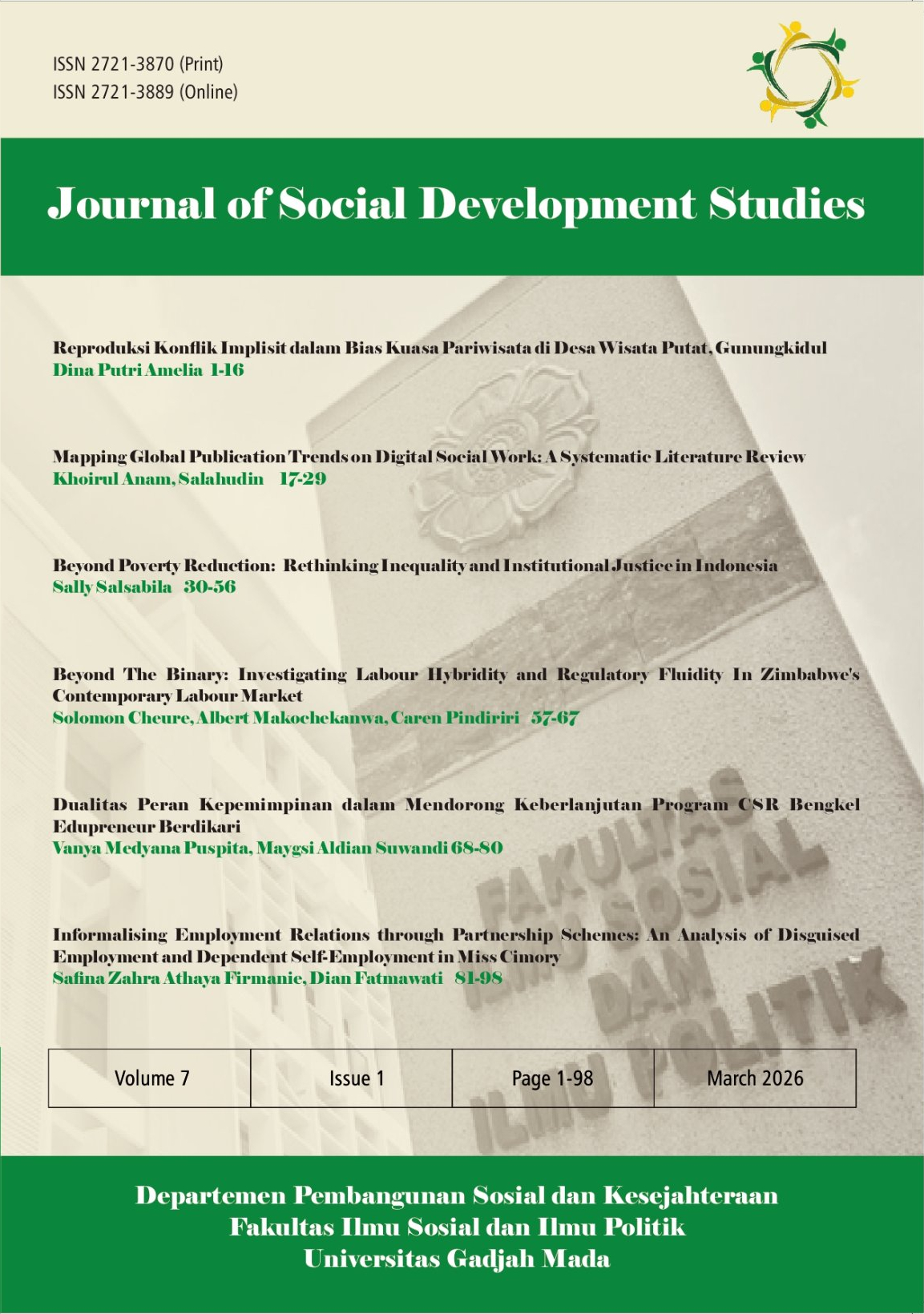
Informalising Employment Relations through Partnership Schemes: An Analysis of Disguised Employment and Dependent Self-Employment in Miss Cimory
DOI:
https://doi.org/10.22146/jsds.30258Keywords:
informal workers; partnership; disguised employment; dependent self-employment; Miss CimoryAbstract
The increasing informalization of work has transformed the labor structure and encouraged the emergence of various forms of employment relationships, including the partnership scheme. In practice, companies may adopt partnership schemes that create disguised employment relationships or dependent self-employment (Izzati, 2021). Within labour studies, disguised employment is a condition in which workers' employment status is concealed, and dependent self employment is a condition in which workers are formally self-employed but remain economically dependent because they are subject to labour process control. One program that adopts a partnership scheme is Miss Cimory which recruits homemakers as entrepreneurs to sell Cimory products directly to households. This study aims to analyse whether the partnership scheme in the Miss Cimory program exhibits these characteristics. This study employs a qualitative approach with a descriptive design. Data were collected through in-depth interviews, observation, and document analysis. The findings indicate that although Miss Cimory participants are formally positioned as partners, in practice, there is economic dependency and indications of control over the labour process. These findings suggest that the Miss Cimory partnership represents a form of dependent self-employment with a tendency toward disguised employment, highlighting the need to strengthen worker protection within partnership-based work arrangements.
References
Albelda, R., Bell-Pasht, A., & Konstantinidis, C. (2019). Gender and Precarious Work in the United States: Evidence from the Contingent Work Supplement 1995-2017.
Allen, E. R. (2016). Analysis of Trend and Challenges in the Indonesian Labor Market. Analysis of trends and challenges in the Indonesian labor market. Asian Development Bank
Annazah, N. S., Tobing, H., Nasution, F. A. P., & Muhyiddin, M. (2023). Kondisi Kerja dalam Relasi Kemitraan: Studi Kasus pada Mitra Perusahaan Transportasi Online. Jurnal Ketenagakerjaan, 18(3), 198-212. https://doi.org/10.47198/jnaker.v18i3.305
Arrasy, F. & Haganta, K. (2024). Diberdayakan atau Diperdaya?: Meninjau “Pemberdayaan Perempuan” dalam Kemitraan Miss Cimory. In A. Hernawan, A. Novianto, & A. D. Wulansari (Eds.), Kemitraan Semu dalam Ekonomi Gig di Indonesia (hal. 37-54). IGPA Press.
Badan Pusat Statistik. (2026). Keadaan Angkatan Kerja di Indonesia November 2025. https://www.bps.go.id/id/pressrelease/2026/02/05/2547/november-2025--tingkat-pengangguran-terbuka--tpt--sebesar-4-74-persen-dan-rata-rata-upah-buruh-sebesar-3-33-juta-rupiah-.html accessed on 1 May 2026.
Badan Pusat Statistik Kabupaten Sukabumi. (2025). Kabupaten Sukabumi dalam Angka 2025. https://sukabumikab.bps.go.id/id/publication/2025/02/28/f8ba38bcb07aecd69affd6da/kabupaten-sukabumi-dalam-angka-2025.html accessed on 1 May 2026
Basjir, W. W. (2003). Informalisasi dan tantangan perburuhan. Jurnal Analisis Sosial, 8(3), 1-20.
Blau, F. D., & Winkler, A. E. (2017). Women, work, and family (Working Paper No. 23644). National Bureau of Economic Research. https://doi.org/10.3386/w23644
Bieber, F., & Moggia, J. (2021). Risk Shifts in the Gig Economy: The Normative Case for an Insurance Scheme against the Effects of Precarious Work*. Journal of Political Philosophy, 29(3). https://doi.org/10.1111/jopp.12233
Cimory. (n.d.). Keberlanjutan: Pemberdayaan Perempuan. https://cimory.com/sustainability.php accessed on 17 July 2026.
Cimory. (2024a). Laporan Keberlanjutan 2024: Pioneering Sustainable Change (Menggagas Perubahan yang Berkelanjutan). https://cimory.com/uploads/investors/Sustainability%20Report%20CMRY%202024.pdf accessed on 17 July 2026.
Cimory. (2024b). Laporan Tahunan 2024: Driving Innovation for a Sustainable Future (Mendorong Inovasi untuk Masa Depan yang Berkelanjutan). https://cimory.com/uploads/investors/Annual%20Report%20CMRY%202024.pdf accessed on 17 July 2026.
Cimory. (2025). Laporan Tahunan 2025: Trusted Nutrition, Powered by Innovation (Nutrisi Tepercaya, Digerakkan oleh Inovasi). https://cimory.com/uploads/investors/Interactive%20AR%20CMRY%202025_8MB.pdf accessed on 1 May 2026.
Cimory. (2026). Cimory Group Apresiasi Peran Strategis Ibu Rumah Tangga melalui Miss Cimory Awards 2025. https://cimory.com/news-detail.php?news_id=30 accessed on 17 July 2026.
Dahayu, C. S. & Budhisulistyawati, A. (2020). Tinjauan Yuridis Tentang Pelaksanaan Perjanjian Kerjasama Kemitraan (Studi Kasus Di Brownies Cinta Cabang Sragen). Jurnal Privat Law, (8)1.
Damiri, D. M., & Alexandri, M. B. (2017). Industrial Relations: Comparative Non-standard Employment Relationship in Nigeria and Indonesia. AdBispreneur: Jurnal Pemikiran dan Penelitian Administrasi Bisnis dan Kewirausahaan, 2(1). https://doi.org/10.24198/adbispreneur.v2i1.12881
Dell’Anno, R., Davidescu, A. A., & Manta, E. M. (2024). The role of the informal economy in achieving the sustainable development goals in europe. Amfiteatru Economic, 26(Special Issue No. 18), 1018-1125.
Dewanta, I. M. T., Rizal, M. C., & Farid, M. L. R. (2023). Menyoal Tuntutan Driver Online terhadap Perubahan Hubungan Kemitraan Menjadi Hubungan Kerja dalam Perspektif Hukum Ketenagakerjaan Indonesia. DiH: Jurnal Ilmu Hukum, 53-61. https://doi.org/10.30996/dih.v19i1.7387
Dvouletý, O., & Nikulin, D. (2023). Dependent self-employed individuals: Are they different from paid employees?. Employee Relations: The International Journal, 45(3), 704-720. https://doi.org/10.1108/ER-11-2022-0502
Eurostat. (2018). Labour Force Survey (LFS) ad-hoc module 2017 on the self-employed persons. Assessment Report. https://doi.org/10.2785/284
Farianto, W. (2019). Pola Hubungan Hukum Pemberi Kerja Dan Pekerja: Hubungan Kerja Kemitraan dan Keagenan. Jakarta: Sinar Grafika.
Fathikhah, R. A. & Sidik, A. F. (2020). Informalisasi Kerja di Era Platformisasi: Kesejahteraan yang Samar dan Terbatasnya Kebijakan Ketenagakerjaan. In Andi Misbahul Pratiwi (Ed.), Ekonomi Informal di Indonesia: Tinjauan Kritis Kebijakan Ketenagakerjaan. TURC.
Frey, B. (2020). Platform Labor and In Formality: Organization Among Motorcycle Taxi Drivers in Bandung, Indonesia. Antropology of Work Review 41(1): 36-49.
Gallaway, J. H., & Bernasek, A. (2002). Gender and Informal Sector Employment in Indonesia. Journal of Economic Issues, XXXVI(2), 313–321
Gramano, E. (2018). Humans as a Service. The Promise and Perils of Work in the Gig Economy. Work Organisation, Labour & Globalisation, 12(2), 99–102. https://doi.org/10.13169/workorgalaboglob.12.2.0099
Harvey, G., Rhodes, C., Vachhani, S. J., & Williams, K. (2016). Neo-villeiny and the service sector: the case of hyper flexible and precarious work in fitness centres. Work, Employment and Society, 31(1), 19-35. https://doi.org/10.1177/0950017016638023
Hardt, M. & Antonio, N. (2009). Commonwealth. Cambridge: Harvard University Press.
Helali, C. J. (2019) "Women of the World, Unite!: An Interview with Nancy Fraser," CLAMANTIS: The MALS Journal: Vol. 1 : No. 7 , Article 11. Available at: https://digitalcommons.dartmouth.edu/clamantis/vol1/iss7/11
Ika, A. (2026). Kisah "Miss Cimory", dari Teras Rumah, Ibu Rumah Tangga Bangun Aset Keluarga. https://money.kompas.com/read/2026/01/29/165138126/kisah-miss-cimory-dari-teras-rumah-ibu-rumah-tangga-bangun-aset-keluarga accessed on 1 May 2026.
International Labour Organization. (2016). Non-standard employment around the world : understanding challenges, shaping prospects (1st ed.). https://www.ilo.org/publications/major-publications/non-standard-employment-around-world-understanding-challenges-shaping accessed on 1 May 2026.
International Labour Organization. (2023). What is Informal Employment?. https://www.ilo.org/media/5481/download accessed on 1 May 2026.
Izzati, N. R. (2021). Eksistensi Yuridis dan Empiris Hubungan Kerja Non-Standar dalam Hukum Ketenagakerjaan Indonesia. Masalah-Masalah Hukum, 50(3), 290-303. https://doi.org/10.14710/mmh.50.3.2021.290-303
Izzati, N. R. (2022). Disebut Mitra Tapi Tak Ada Payung Hukumnya: ‘Pekerja Gig Economy Tidak Terproteksi’. https://theconversation.com/disebut-mitra-tapi-tak-ada-payung-hukumnya-pekerja-gig-economy-tidak-terproteksi-190464 accessed on 6 July 2026.
Izzati, N. R., & Sesunan, M. M. G. (2022). ‘Misclassified Partnership’ and the Impact of Legal Loophole on Workers. Bestuur, 10(1), 57–67. https://doi.org/10.20961/bestuur.v10i1.62066
Koichi, K. (2020). Legal Issues Surrounding Employment-Like Working Styles: Disguised Employment and Dependent Self-Employment. Japan labor issues/The Japan Institute for Labour Policy and Training, International Research Exchange Section [編], 4(22), 3-22. https://www.jil.go.jp/english/jli/documents/2020/022-01.pdf
Kusnadi, R. J. (2024). Melawan Kerentanan Kerja: Persoalan Kemitraan dan Peran Serikat Pekerja sebagai Alat Perjuangan bagi Pengemudi Ojek Online. In A. Hernawan, A. Novianto, & A. D. Wulansari (Eds.), Kemitraan Semu dalam Ekonomi Gig di Indonesia (hal. 171-186). IGPA Press.
Majanto, L. F. (2002). Studi Profil Pekerja di Sektor Informal dan Arah Kebijakan ke Depan. In Direktorat Ketenagakerjaan dan Analisis Ekonomi.
Mas, P., Agusmidah, & Ningsih, S. . (2022). Studi Komparasi Hubungan Kerja Non-Standar Dependent Self Employment dalam Hukum Ketenagakerjaan di Indonesia dan Hukum Inggris Pada Era Gig Economy. Mahadi: Indonesia Journal of Law, 1(2), 181–199. https://doi.org/10.32734/mah.v1i2.9024
Maulana, A. (2020). Penyelundupan Hukum Dengan Menggunakan Hubungan Kemitraan Pada Status Yang Seharusnya Hubungan Kerja Yang Dilakukan Oleh Perusahaan Dengan Pekerjannya. Jurnal Suara Keadilan, 21(1), 17-29.
Miles, M. B., Huberman, A. M., Saldaña, J. (2014). Qualitative Data Analysis: A Methods Sourcebook. California: SAGE.
Novianto, A., Keban, Y. T., & Hernawan, A. (2021). “Mendorong Kerja Layak & Adil bagi Pekerja Gig: Kajian Awal tentang Ekonomi Gig di Indonesia”. Dalam Y. T. Keban, A. Hernawan, & A. Novianto (Eds.), Menyoal Kerja Layak dan Adil dalam Ekonomi Gig di Indonesia (hal. iii-xxviii). IGPA Press.
Novianto, A., Wulansari, A. D., & Hernawan, A. (2021). “Riset Empat Alasan Kemitraan Gojek, Grab, hingga Maxim Merugikan Para Ojol”. The Conversation. https://theconversation.com/riset-empat-alasan-kemitraan-gojek-grab-hingga-maxim-merugikan-para-ojol-159832
Novianto, A., Wulansari, A. D., & Hernawan, A. (2024). Pekerja Berstatus Mitra Sebagai Kaum Marhaen Abad 21: Terjerat Kemitraan Semu dan Apa yang Harus Dilakukan. In A. Hernawan, A. Novianto, & A. D. Wulansari (Eds.), Kemitraan Semu dalam Ekonomi Gig di Indonesia (hal. 1-18). IGPA Press.
OECD (2018), Good Jobs for All in a Changing World of Work: The OECD Jobs Strategy, OECD Publishing, Paris. https://doi.org/10.1787/9789264308817-en
Rukmana, N. (2006). Strategic Partnering For Educational Management: Model manajemen pendidikan berbasis kemitraan jawaban atas polemik penyelenggaraan pendidikan kedinasan, Jakarta: ALFABETA
Samman, E., Presler-Marshall, E., Jones, N., Bhatkal, T., Melamed, C., Stavropoulou, M. and Wallace, J. (2016) Women’s work: mothers, children and the global childcare crisis. London: Overseas Development Institute. www.odi.org/sites/odi.org.uk/files/odi-assets/publications-opinion-files/10333.pdf
Sari, N. P. (2016). Transformasi Pekerja Informal ke Arah Formal: Analisis Deskriptif dan Regresi Logistik Informal Worker Transformation to Formal Sector: Descriptive and Logistic Regression Analyses. Jurnal Ekonomi Kuantitatif Terapan, 9(1).
Schüring, E., & Loewe, M. (2021). Handbook On Social Protection Systems. In Handbook on Social Protection Systems. Edward Elgar Publishing. https://doi.org/10.4337/9781839109119
Sprague, R. (2015). Worker (Mis)Classification in the Sharing Economy: Trying to Fit Square Pegs into Round Holes. ABA Journal of Labor & Employment Law, 31(1), 53-76. https://doi.org/10.2139/ssrn.2606600
Standing, G. 1999. Global feminization through flexible labor: A theme revisited. World Development 27(3): 583-602.
Suhartono, S., Tjahjono, A., Nugroho, M. A. S., Umam, M. C., & Afifa, R. A. (2025). Marketing Partnership: Kemitraan Dalam Bisnis. JCSE: Journal of Community Service and Empowerment, 6(1), 16-24. https://doi.org/10.32639/5s0phy18
Sunardi. (2021). “Ilusi Insentif di Gojek: Cara Perusahaan Platform Mengontrol Pekerja Gig dalam Relasi Kemitraan yang Semu”. Dalam Y. T. Keban, A. Hernawan, & A. Novianto (Eds.), Menyoal Kerja Layak dan Adil dalam Ekonomi Gig di Indonesia (hal. 63-77). IGPA Press.
Sundararajan, A. (2016). The sharing economy: The end of employment and the rise of crowd-based capitalism. MIT press.
Syafitri, W., & Muara Setyanti, A. (2026). What Drives Women Participation in Vulnerable Jobs? An Empirical Analysis in Indonesia. Buletin Ekonomika Pembangunan, 7(1), 2807–4998. https://doi.org/10.21107/bep.v7i1.31150
Tekeli-Yesil, S., & Kiran, S. (2020). A Neglected Issue in Hospital Emergency and Disaster Planning: Non-Standard Employment in Hospitals. International Journal of Disaster Risk Reduction, 51(December 2020), 101823. https://doi.org/10.1016/j.ijdrr.2020.101823
Tjandraningsih, I. (2012). State-sponsored precarious work in Indonesia. American Behavioral Scientist, 57(4), 403-419.
Tjandraningsih, I. (2020). Pekerja informal dan reformasi kebijakan ketenagakerjaan di Indonesia: Praktik dan tantangan kebijakan. In Andi Misbahul Pratiwi (Ed.), Ekonomi Informal di Indonesia: Tinjauan Kritis Kebijakan Ketenagakerjaan. TURC.
Tuwu, D. (2018). Peran pekerja perempuan dalam memenuhi ekonomi keluarga: dari peran domestik menuju sektor publik. Al-Izzah: Jurnal Hasil-Hasil Penelitian, 63-76.
Uwiyono, A. (2014). Asas-Asas Hukum Ketenagakerjaan. Depok: Raja Grafindo Persada.
Wirba, E. L., Akem, F. A., & Baye, F. M. (2021). Earnings gap between men and women in the informal labor market in Cameroon. Review of Development Economics, 25(3), 1466-1491. https://doi.org/10.111/rode.12765
Yasih, D.W.P. (2025). Precarious Workers in the Gig Economy: Neoliberalism and its Discontents in Indonesia (2025th ed.). Palgrave Macmillan.
Yuliani, W. (2018). Metode Penelitian Deskriptif Kualitatif dalam Perspektif Bimbingan dan Konseling. QUANTA: Kajian Bimbingan Dan Konseling Dalam Pendidikan, 2(2), 83–91. https://doi.org/10.22460/q.v2i2p83-91.1641
Zega, S. E. N. (2024). Ilusi Feminisasi Kerja: Kerawanan Kerja Yakult Lady Akibat Sistem Kerja Gig dan Ketiadaan Perlindungan di Ranah Reproduksi Sosial. In A. Hernawan, A. Novianto, & A. D. Wulansari (Eds.), Kemitraan Semu dalam Ekonomi Gig di Indonesia (hal. 73-90). IGPA Press.