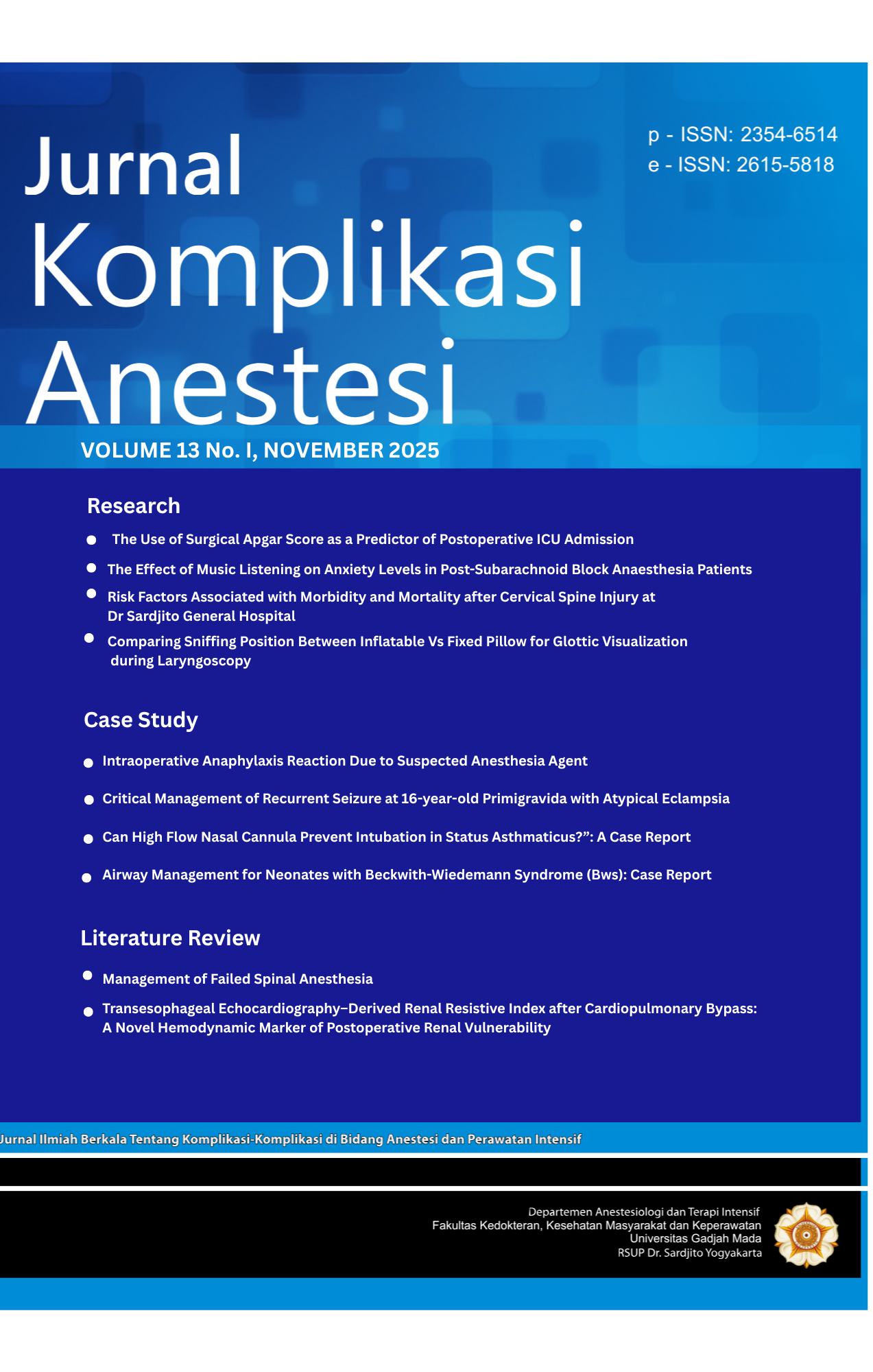
Critical Management of Recurrent Seizure at 16-year-old Primigravida with Atypical Eclampsia
DOI:
https://doi.org/10.22146/jka.v13i1.14972Keywords:
Atypical eclampsia, dexmedetomidine, midazolam, seizure, teenage pregnancyAbstract
Background: Atypical eclampsia can complicate the management and pose significant risks to both the mother and fetus. This case report emphasizes the critical management approach for recurrent seizures in a young primigravida. Case: A 16-year-old primigravida presented with sudden onset seizures during her third trimester of pregnancy. Initial assessments showed only a slight elevation of blood pressure and proteinuria, suggesting the presence of atypical eclampsia. Despite initially administering MgSO4, the patient still experienced a postpartum seizure. She was closely monitored and given a maintenance dose of midazolam and dexmedetomidine. After five days of treatment, the patient did not have any further convulsions and remained stable. Discussion: Teenage pregnancies increase the risk of maternal fatalities due to eclampsia. Atypical eclampsia is rare but can occur and requires a specific treatment approach. When therapy with magnesium sulfate is ineffective, midazolam and dexmedetomidine are used as alternative anti-epileptic drugs. Dexmedetomidine has a neuroprotective effect, preventing cerebral ischemia, and is effective in reducing the need for antihypertensive medication and hospitalization. Conclusion: The successful utilization of a combination of midazolam and dexmedetomidine highlights their potential as an effective therapeutic option for refractory seizures and adds to the existing treatment armamentarium for eclampsia.
References
Moodley J, Ngene NC. Maternal deaths due to eclampsia in teenagers: Lessons from assessment of maternal deaths in South Africa. Afr J Prim Health Care Fam Med. 2020 ;12(1):e1-e6. Doi: 10.4102/phcfm.v12i1.2305
NICE guideline. Hypertension in pregnancy: diagnosis and management. London: National Institute for Health and Care Excellence (NICE). 2019, 133. Available from: https://www.ncbi.nlm.nih.gov/books/NBK546004/.
Cipolla MJ, Kraig RP. Seizures in Women with Preeclampsia: Mechanisms and Management. Fetal Matern Med Rev. 2011;22(2):91-108. Doi: 10.1017/S0965539511000040
Putri RWY, Mahroos RE. Atypical eclampsia at primary health care in a remote area: A case report. World J Obstet Gynecol. 2023; 12(4): 45-50.
Maturu MVS, Pappu S, Datla AV, Devara A, Dalai S. Atypical Presentation of Antenatal Eclampsia. Cureus. 2022;14(5):1-7. Doi: 10.7759/cureus.24745
Fishel Bartal M, Sibai BM. Eclampsia in the 21st century. Am J Obstet Gynecol. 2022 ;226(2S):S1237-S1253. Doi: 10.1016/j.ajog.2020.09.03
Dag ZO, Isik Y, Turkel Y, Alpua M, Simsek Y. Atypical eclampsia and postpartum status epilepticus. Pan Afr Med J. 2015;20:17:1-3. Doi: 10.11604/pamj.2015.20.17.5831
Roberti R, Rocca M, Iannone LF, Gasparini S, Pascarella A, Neri S, et al. Status epilepticus in pregnancy: a literature review and a protocol proposal. Expert Rev Neurother. 2022;22(4):301-12. Doi: 10.1080/14737175.2022.2057224
Harsono AAH, Achmadi A, Aldika Akbar MI, Joewono HT. Recurrent seizures in 2 patients with magnesium sulfate-treated eclampsia at a secondary hospital. Am J Case Rep. 2018;19:1129-1134. Doi: 10.12659/AJCR.911004
Esmaoglu A, Ulgey A, Akin A, Boyaci A. Comparison between dexmedetomidine and midazolam for sedation of eclampsia patients in the intensive care unit. J Crit Care. 2009;24(4):551-55. Doi: 10.1016/j.jcrc.2009.02.001
Downloads
Published
How to Cite
Issue
Section
License
The Contributor and the company/institution agree that all copies of the Final Published
Version or any part thereof distributed or posted by them in print or electronic format as permitted herein will include the notice of copyright as stipulated in the Journal and a full citation to the Journal.