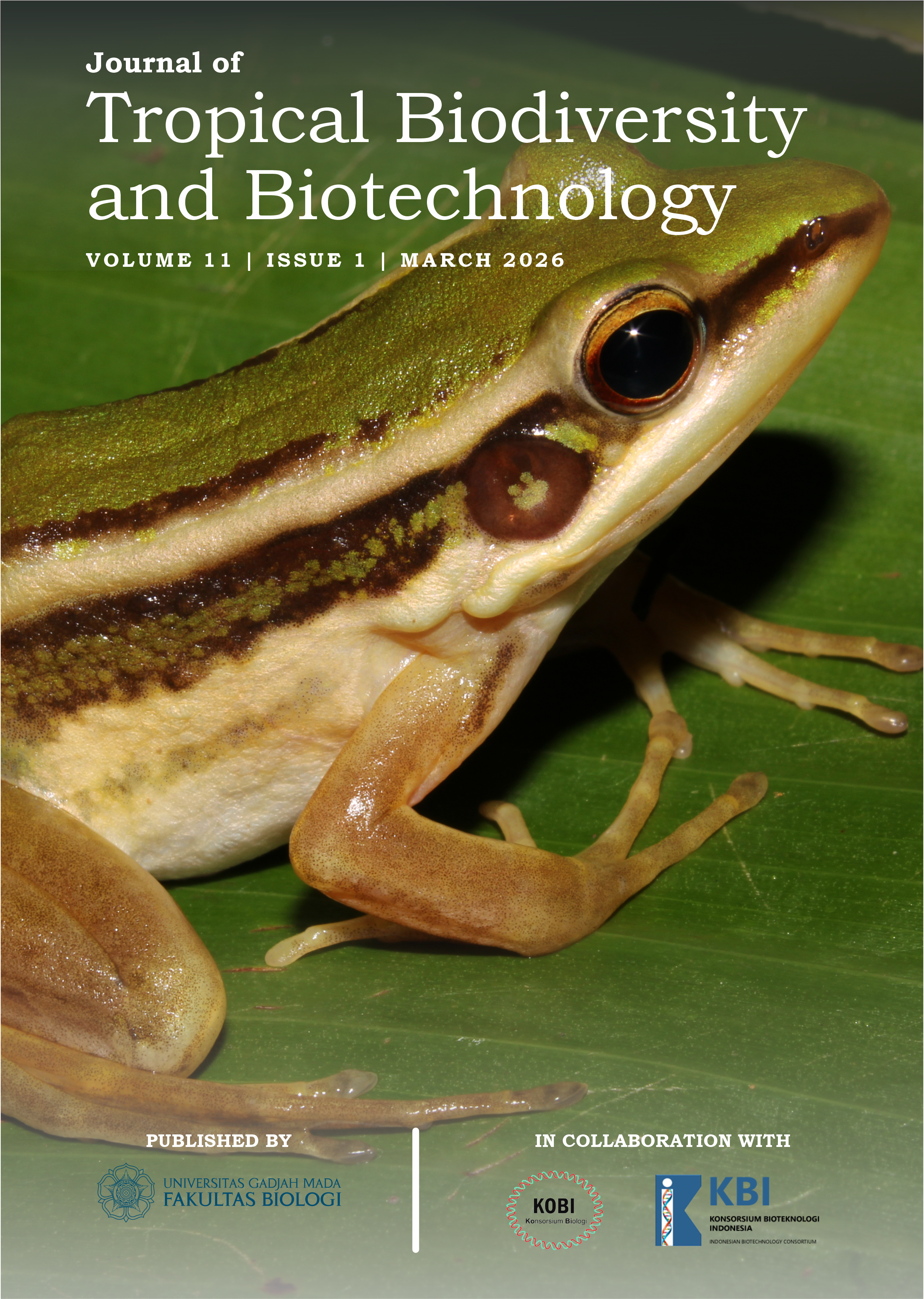
Metagenomics Profile of Bacterial Community and Its Biocatalytic Activities of The Cultured Bacteria in Liquid of Pitcher Plant (Nepenthes Adrianii)
Abstract
Nepenthes, commonly known as pitcher plants, are carnivorous plants that catch insects. One species, Nepenthes adrianii, is endemic to Mount Slamet in Central Java. The bacterial community present in the fluid of Nepenthes pitchers is supposed to play a crucial role in digesting trapped insects, converting them into nutrients for the plant. This study investigated the metagenomics profile of the bacterial community found in the fluid of N. adrianii, collected from two different altitudes, and evaluated the biocatalytic activity of cultured bacteria. Next-generation sequencing (NGS) was performed on the V3-V4 hypervariable region of the 16S rRNA gene. Additionally, biocatalytic screening—including cellulolytic, amylolytic, proteolytic, and chitinolytic tests—was conducted by growing bacteria on basal media, each supplemented with 1 % of carboxymethyl cellulose (CMC), starch, skim milk, and colloidal chitin. The formation of a clear zone in the media indicated bacteria with biocatalytic activity, which were subsequently identified molecularly using the 16S rRNA gene. The results indicated that the four most abundant bacterial phyla were Proteobacteria, Firmicutes, Bacteroidota, and Actinobacteria, with Proteobacteria having the highest abundance in all altitudes. Bacterial diversity in the fluid of N. adrianii showed high with a Shannon diversity index exceeding three, along with several dominant bacterial species. Bacterial isolates confirmed to have proteolytic activity included Leifsonia aquatica, Bacillus tequilensis, and Bosea lupini. Cellulolytic activity was attributed to Pseudomonas sp. Amylolytic activity was linked to Pseudomonas sp. and a Bacillaceae bacterium, while Pseudomonas aeruginosa exhibited chitinolytic activity.
References
An, C.I., Fukusaki, E.I. & Kobayashi, A., 2002. Aspartic proteinases are expressed in pitchers of the carnivorous plant Nepenthes alata Blanco. Planta, 214(5), pp.661–667. doi: 10.1007/s004250100665.
Aryati, P.C., Pangastuti, A. & Sari, S.L.A., 2017. Amylase production potentials of bacterial isolates obtained from the gut of Oryctes rhinoceros larvae. IOP Conference Series: Materials Science and Engineering, 193, 012006. doi: 10.1088/1757-899X/193/1/012006.
Batoro, J. & Wartono, A., 2017. Review status the Nepenthes (Nepenthaceae). Indian Journal of Plant Sciences, 6(1), pp.12–16.
Bittleston, L.S., 2018. Commensals of Nepenthes pitchers. In Carnivorous Plants: Physiology, Ecology, and Evolution. Oxford University Press. doi: 10.1093/oso/9780198779841.003.0023
Callahan, B.J. et al., 2016. DADA2: High-resolution sample inference from Illumina amplicon data. Nature methods, 13(7), pp.581-583. doi: 10.1038/nmeth.3869.
Chan, X.Y. et al., 2016. Microbiome and Biocatalytic Bacteria in Monkey Cup (Nepenthes Pitcher) Digestive Fluid. Scientific Reports, 6, 20016. doi: 10.1038/srep20016.
Choi, Y.W., Hodgkiss, I.J. & Hyde, K.D., 2005. Enzyme production by endophytes of Brucea javanica. Water, pp.55–66.
Chou, L.Y., Clarke, C.M. & Dykes, G.A., 2014. Bacterial communities associated with the pitcher fluids of three Nepenthes (Nepenthaceae) pitcher plant species growing in the wild. Archives of microbiology, 196(10), pp.709–717. doi: 10.1007/s00203-014-1011-1.
Chauhan, M. et al., 2023. Cold adapted Pseudomonas: ecology to biotechnology. Frontiers in Microbiology, 14, 1218708. doi: 10.3389/fmicb.2023.1218708.
Dewiyanti, I. et al., 2022. Characteristic and activity of cellulolytic bacteria isolated from mangrove soil in Northern Coast of Aceh Province, Indonesia. Biodiversitas, 23(12), pp.6587–6599. doi: 10.13057/biodiv/d231258.
Dkhar, J. et al., 2020. Pitchers of Nepenthes khasiana express several digestive-enzyme encoding genes, harbor mostly fungi and probably evolved through changes in the expression of leaf polarity genes. BMC Plant Biology, 20, 524. doi: 10.1186/s12870-020-02663-2.
Dos Santos. et al., 2019. A 16S rDNA PCR-based theoretical to actual delta approach on culturable mock communities revealed severe losses of diversity information. BMC Microbiology, 19, 74. doi: 10.1186/s12866-019-1446-2.
Folders, J. et al., 2001. Characterization of pseudomonas aeruginosa chitinase, a gradually secreted protein. Journal of Bacteriology, 183(24), pp.7044–7052. doi: 10.1128/JB.183.24.7044-7052.2001.
Gilbert, KJ., Bittleston, LS., & Tong, W., 2020a. Tropical pitcher plants (Nepenthes) act as ecological filters by altering properties of their fluid microenvironments. Scientific Reports,10, 4431. doi: 10.1038/s41598-020-61193-x.
Gilbert, K.J. et al., 2020b. Investigation of an Elevational Gradient Reveals Strong Differences Between Bacterial and Eukaryotic Communities Coinhabiting Nepenthes Phytotelmata. Microbial Ecology, 80(2), pp.334–349. doi: 10.1007/s00248-020-01503-y.
Gopinath, S.C.B. et al., 2017. Biotechnological Processes in Microbial Amylase Production. BioMed Research International, 2017, 1272193. doi: 10.1155/2017/1272193.
Kanokratana, P. et al., 2016. Comparative Study of Bacterial Communities in Nepenthes Pitchers and Their Correlation to Species and Fluid Acidity. Microbial Ecology, 72(2), pp.381–393. doi: 10.1007/s00248-016-0798-5.
Koteshwara, A., 2021. Simple methods for the preparation of colloidal chitin, cell free supernatant and estimation of laminarinase. Bio Protocol, 11(19), e4176. doi: 10.21769/BioProtoc.4176.
Martin, M., 2011. Cutadapt removes adapter sequences from high-throughput sequencing reads. EMBnet. Journal, 17(1), pp.10-12. doi: 10.14806/ej.17.1.200.
Morohoshi, T. et al., 2011. Isolation and characterization of novel lipases from a metagenomic library of the microbial community in the pitcher fluid of the carnivorous plant Nepenthes hybrida. Journal of Bioscience and Bioengineering, 112(4), pp.315–320. doi: 10.1016/j.jbiosc.2011.06.010.
Ni’matuzahroh et al., 2024. Biodiversity of hydrolytic enzymes-producing soil bacteria from a Durian Park, Jombang, Indonesia: Beneficial prospect for sustainable agriculture. Biodiversitas, 25(1), pp.392–403. doi: 10.13057/biodiv/d250146.
Piotrowska-Długosz, A. et al., 2022. Enzymatic activity and functional diversity of soil microorganisms along the soil profile a matter of soil depth and soil-forming processes. Geoderma, 416, 115779. doi: 10.1016/j.geoderma.2022.115779
Razzaq, A. et al., 2019. Microbial proteases applications. Frontiers in Bioengineering and Biotechnology, 7, 110. doi: 10.3389/fbioe.2019.00110.
Rutu, I., Natsir, H. & Arfah, R., 2015. Production of Protease Enzyme from Bacteria in Hot Spring of South Sulawesi, Bacillus licheniformis HSA3-1a. Marina Chimica Acta, 16(1), pp.10–17.
Sari, S. et al., 2016. Cellulolytic and hemicellulolytic bacteria from the gut of oryctes rhinoceros larvae. Biodiversitas, 17(1), pp.78- 83. doi: 10.13057/biodiv/d170111
Sickel, W. et al., 2016. Bacterial diversity and community structure in twobornean Nepenthes species with difference in nitrogen acquistion strategies. Microbiology Ecology, 71(4), pp.938-953. doi: 10.1007/s00248-015-0723-3
Syah, M.A., Yaddi, Y. & Ulfa, N.I., 2024. Identifikasi Molekuler Bakteri Lipolitik Yang Diisolasi Dari Sedimen Mangrove Teluk Kendari. BioWallacea: Jurnal Penelitian Biologi (Journal of Biological Research), 11(1), pp.68–77.
Takeuchi, Y. et al., 2015. Bacterial diversity and composition in the fluid of pitcher plants of the genus Nepenthes. Systematic and Applied Microbiology, 38(5), pp.330–339. doi: 10.1016/j.syapm.2015.05.006.
Tan, W.Y. et al., 2023. Bio-Enzyme Hybrid with Nanomaterials: A Potential Cargo as Sustainable Biocatalyst. Sustainability (Switzerland), 15(9), 7511. doi: 10.3390/su15097511.
Waskita, Y. et al., 2024. Potency of tubers and rhizomes of Java local foods as prebiotics and their effects toward bacterial diversity in mice cecum. Biodiversitas, 25(4), pp.1544–1553. doi: 10.13057/biodiv/d250423.
Zakavi, M., Askari, H. & Shahrooei, M., 2022. Bacterial diversity changes in response to an altitudinal gradient in arid and semi-arid regions and their effects on crops growth. Frontiers in Microbiology, 13, 984925. doi: 10.3389/fmicb.2022.984925.
Zhang, W. et al., 2020. Identification of bacteria associated with periapical abscesses of primary teeth by sequence analysis of 16S rDNA clone libraries. Microbial Pathogenesis, 141, 103954. doi: 10.1016/j.micpath.2019.103954.
Zhou, Z. et al., 2020. Genome diversification in globally distributed novel marine Proteobacteria is linked to environmental adaptation. ISME Journal, 14(8), pp.2060–2077. doi: 10.1038/s41396-020-0669-4.