



Physical Isolation as a Low-Cost Strategy to Mitigate Electrochemical Interference in pH–DO (Dissolved Oxygen) Multisensor Systems
 https://doi.org/10.22146/juliet.v7i2.119263
Riski Fitriani(1*), Bernadus Herdi Sirenden(2), Irmansyah Irmansyah(3), Erus Rustami(4), Alwi Supandi(5), Fito Wigunanto Herminawan(6)
(1) Department of Physics, IPB University and Research Center for Electronics, National Research & Innovation Agency
(2) Research Center for Electronics, National Research & Innovation Agency
(3) Department of Physics, IPB University
(4) Department of Physics, IPB University
(5) Department of Physics, Jenderal Soedirman University
(6) Research Center for Electronics, National Research & Innovation Agency
(*) Corresponding Author
Abstract
Full Text:
PDFReferences
G. Cornetta et al., “An open-source educational platform for multi-sensor environmental monitoring applications,” Hardware, vol. 3, no. 4, Art. no. 13, Oct. 2025, doi: 10.3390/hardware3040013.
M. Iqbal, “Remote multisensor system for environmental quality (water and air) monitoring applications in aquaculture environments based on the Internet of Things,” Sunan Kalijaga J. Phys., vol. 5, no. 1, pp. 1–10, 2023, doi: 10.14421/physics.v5i1.3353.
E. Akpokodje et al., “A multi-sensing technology approach for the environmental monitoring of the Ystwyth River,” Sensors, vol. 25, Art. no. 6743, 2025, doi: 10.3390/s2516743.
G. Cui et al., “Optical fiber pH and dissolved oxygen sensors for bioreactor monitoring: A review,” Sensors, vol. 26, no. 1, Art. no. 10, 2026, doi: 10.3390/s26010010.
A. Pavlidou, I. Hoteit, and A. Martins, “Recent advances in water quality monitoring,” Remote Sens., vol. 18, no. 5, Art. no. 820, 2026, doi: 10.3390/rs18050820.
M. S. Bakare and K. Abubaker, “IoT-based indoor environmental monitoring system using multi-parameter sensing and ESP32-WROOM integration,” Discov. Electron., vol. 3, Art. no. 6, 2026, doi: 10.1007/s44291-026-00157-3.
V. Radhika, K. Srinivasan, R. Ramya, and B. B. Sharmila, “IoT-based water quality and quantity monitoring system for domestic usage,” in Immersive Technologies in Healthcare, Cham, Switzerland: Springer, 2021, doi: 10.1007/978-3-030-66607-1_10.
A. V. Gurskaya and S. S. Ermakov, “Electrochemical sensor for dissolved oxygen with a flow-through working electrode,” Russ. J. Appl. Chem., vol. 88, no. 5, pp. 782–786, 2015, doi: 10.1134/S1070427215050109.
G. Hanrahan, G. Patil, and J. Wang, “Electrochemical sensors for environmental monitoring: Design, development and applications,” J. Environ. Monit., vol. 6, pp. 657–664, 2004, doi: 10.1039/B403975K.
H. Liu et al., “Research on the influence of core sensing components on the performance of galvanic dissolved oxygen sensors,” Sensors, vol. 24, no. 13, Art. no. 4155, 2024, doi: 10.3390/s24134155.
S. Rijal et al., “Electrical and electrochemical pH sensing technologies: Comparative mechanisms, performance, and applications,” J. Solid State Electrochem., vol. 30, pp. 1869–1878, 2026, doi: 10.1007/s10008-026-06534-y.
Y. Wei, Y. Jiao, D. An, D. Li, W. Li, and Q. Wei, “Review of dissolved oxygen detection technology: From laboratory analysis to online intelligent detection,” Sensors, vol. 19, no. 18, Art. no. 3995, 2019, doi: 10.3390/s19183995.
M. C. DeBrosse, S. Suresh, A. Karajic, S. Kim, S. Hussain, and J. Heikenfeld, “A novel conductive membrane sensor protection technique to mitigate redox-active interferences,” Biosens. Bioelectron. X, vol. 14, Art. no. 100366, 2023, doi: 10.1016/j.biosx.2023.100366.
M. Zhao, D. B. Hibbert, and J. J. Gooding, “Solution to the problem of interferences in electrochemical sensors using the fill-and-flow channel biosensor,” Anal. Chem., vol. 75, no. 3, pp. 593–600, 2003, doi: 10.1021/ac026072l.
L. Liu, D. Zhao, and Y. Qin, “Analysis and solution on the correlation between dissolved oxygen sensor and pH sensor for water quality monitoring,” Appl. Mech. Mater., vols. 411–414, pp. 1445–1450, 2013, doi: 10.4028/www.scientific.net/AMM.411-414.1445.
I. Seymour, B. O. Sullivan, P. Lovera, J. F. Rohan, and A. O. Riordan, “Elimination of oxygen interference in the electrochemical detection of monochloramine, using in situ pH control at interdigitated electrodes,” ACS Sensors, vol. 6, pp. 1030–1038, 2021, doi: 10.1021/acssensors.0c02264.
S. Sharma, D. Mishra, A. Yadav, B. Gami, and E. S. Madhan, “An intelligent, low-cost water quality monitoring system with on-device machine learning and cloud integration,” Sci. Rep., vol. 16, Art. no. 11106, 2026, doi: 10.1038/s41598-026-37287-3.
Z. Wang, P. Osmond, B. Shi, M. Janmohammadi, and K. Zhang, “Next-generation water quality monitoring: Sensor-based deep learning prediction and calibration optimization in urban rivers,” J. Hydrol., vol. 666, Art. no. 134715, Feb. 2026, doi: 10.1016/j.jhydrol.2025.134715.
I. Essamlali, H. Nhaila, and M. El Khaili, “Advances in machine learning and IoT for water quality monitoring: A comprehensive review,” Heliyon, vol. 10, no. 6, Art. no. e27920, 2024, doi: 10.1016/j.heliyon.2024.e27920.
Y. Zhao, H. Zhang, Q. Jin, D. Jia, and T. L., “Ratiometric optical fiber dissolved oxygen sensor based on fluorescence quenching principle,” Sensors, vol. 22, no. 13, Art. no. 4811, 2022, doi: 10.3390/s22134811.
N. Shaghaghi et al., “DOxy: A dissolved oxygen monitoring system,” Sensors, vol. 24, no. 10, Art. no. 3253, 2024, doi: 10.3390/s24103253.
Y. Qin, H. Kwon, M. M. R. Howlader, and M. J. Deen, “Chlorine sensors for water quality monitoring: Recent advances and research challenges,” RSC Adv., vol. 5, pp. 69086–69109, 2015, doi: 10.1039/C5RA11291E.
Y. Yang et al., “Problems analysis and new fabrication strategies of mediated electrochemical biosensors for wastewater toxicity assessment,” Biosens. Bioelectron., vol. 108, pp. 82–88, 2018, doi: 10.1016/j.bios.2018.02.049.
E. Bakker and E. Pretsch, “Potentiometric sensors for trace-level analysis,” TrAC Trends Anal. Chem., vol. 24, no. 3, pp. 199–207, 2005, doi: 10.1016/j.trac.2005.01.003.
J. Wang, Analytical Electrochemistry, 3rd ed. Hoboken, NJ, USA: John Wiley & Sons, 2006, doi: 10.1002/0471790303.
British Standards Institution, Metallic Materials—Calibration of Force-Proving Instruments Used for the Verification of Uniaxial Testing Machines, 4th ed. London, U.K.: BSI, 2011, doi: 10.3403/30168925U.
U.S. Geological Survey, Handbooks for Water-Resources Investigations, Techniques and Methods, book 9, chap. A6.2, 2020, doi: 10.3133/tm9A6.2.
B. B. Benson and D. Krause, “The concentration and isotopic fractionation of oxygen dissolved in freshwater and seawater in equilibrium with the atmosphere,” Limnol. Oceanogr., vol. 29, no. 3, pp. 620–632, 1984, doi: 10.4319/lo.1984.29.3.0620.
DOI: https://doi.org/10.22146/juliet.v7i2.119263
Article Metrics
 Abstract views : 0
|
 views : 0
Refbacks
- There are currently no refbacks.
Copyright (c) 2026 Jurnal Listrik, Instrumentasi, dan Elektronika Terapan

This work is licensed under a Creative Commons Attribution-NonCommercial-NoDerivatives 4.0 International License.
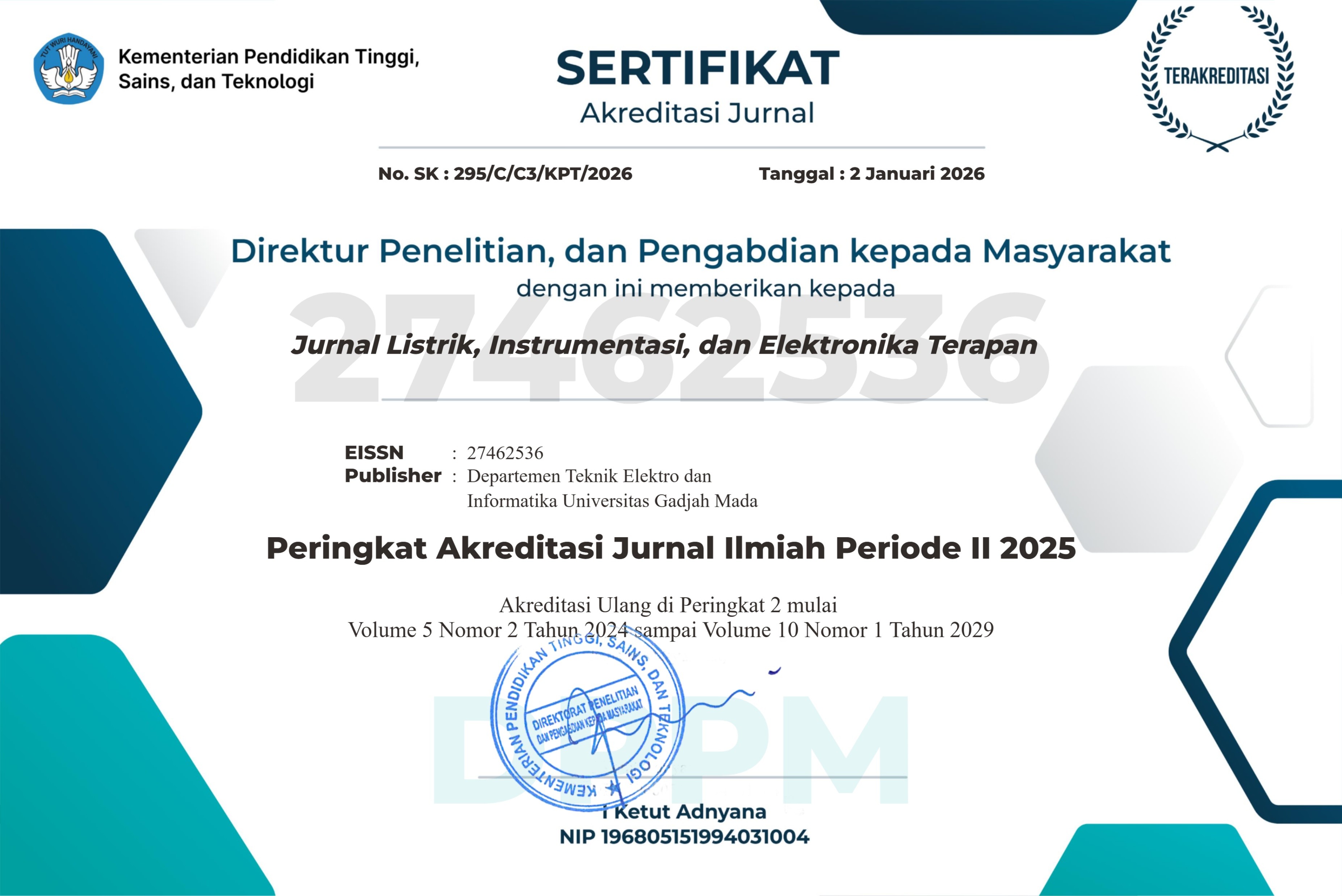
SINTA 2 accredited based on Decree of the Director General of Research and Development, Ministry of Higher Education, Science and Technology No. 295/C/C3/KPT/2026, Vol. 5 No. 2 (2024) - Vol. 10 No. 1 (2029)
e-ISSN: 2746-2536