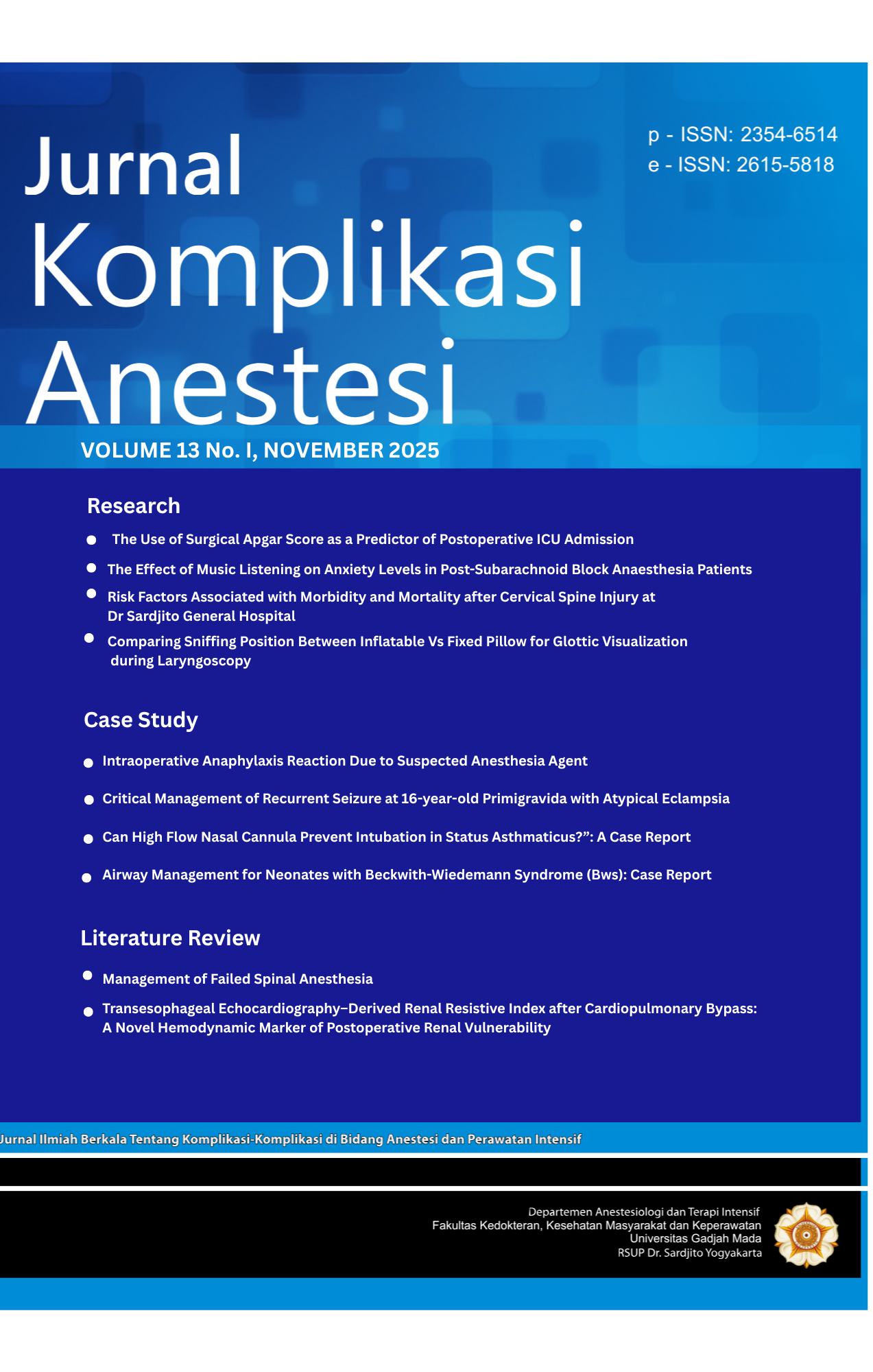
Management of Failed Spinal Anesthesia
DOI:
https://doi.org/10.22146/jka.v13i1.27741Keywords:
Anesthesia complications, management, spinal anesthesia, spinal anesthesia failure, regional anesthesiaAbstract
The management of failed spinal anesthesia is a significant challenge in surgical procedures. Spinal anesthesia failure can occur either partially or totally, often leading to conversion to general anesthesia, which adds clinical risks and potential complications. The aim of this study is to evaluate the factors contributing to spinal anesthesia failure and identify effective management strategies. The study found that factors such as patient positioning, anesthesiologist experience, the number of attempts, and patient BMI significantly influenced spinal block success. Total spinal anesthesia failure often requires conversion to general anesthesia, whereas partial failures can be managed with adjuvant medications or repeated procedures. Understanding the management of failed spinal anesthesia is essential for providing safe and effective care
References
Boztaş N, Ozbilgin S, Karcı A, Akan M, Muçuoglu CA, Arça DO, Emecen AN. Perfusion index as a predictor of successful spinal anesthesia: A time-dependent receiver operating characteristics curve analysis. South. Clin. Ist. Euras. 2021;32(2):125–30. Doi: 10.14744/scie.2021.90692
Demilie AE, Denu ZA, Bizuneh YB, Gebremedhn EG. Incidence and factors associated with failed spinal anesthesia among patients undergoing surgery: a multi-center prospective observational study. BMC Anesthesiol. 2024;24(1):1-13. Doi:10.1186/s12871-024-02484-y.
Khan IA, Sharma A. Repeat spinal or general anesthesia: A dilemma! Indian J Clin Anaesth. 2022;9(3):405–406. doi: 10.18231/j.ijca.2022.082.
Chandrashekar AS, Hymel AM, Pennings JS, Wilson JM, Gupta RK, Polkowski GG, et al. Is a failed spinal attempt associated with a worse clinical course following primary total hip and knee arthroplasty? J Arthroplasty. 2024;39(11):2669–74.e1. Doi: 10.1016/j.arth.2024.05.049.
Bagle A, Khatri S, Jain R. Failed Spinal anesthesia: Incidence and associated factors. Cureus. 2024;16(12):e76078. Doi: 10.7759/cureus.76078.
Rae JD, Fettes PDW. Mechanisms and management of failed spinal anesthesia. In: Hadzic A, editor. Hadzic's Textbook of Regional Anesthesia and Acute Pain Management. 2nd ed. New York: McGraw Hill; 2023.
Ashagrie HE, Ahmed SA, Melesse DY. The incidence and factors associated with failed spinal anesthesia among parturients underwent cesarean section, 2019: A prospective observational study. Int J Surg Open. {Internet]. 2020;24: 47-51.[cited 2020 Dec 31]. Doi: Available from: https://journals.lww.com/ijsopen/fulltext/2020/24000/the_incidence_and_factors_associated_with_failed.9.aspx
Manouchehrian N, Rahimi-Bashar F, Pirdehghan A, Shahmoradi F. Comparison between 10 and 12 mg doses of intrathecal hyperbaric (0.5%) bupivacaine on sensory block level after first spinal failure in cesarean section: a double-blind study. Front Med. 2022;9:1-14. Doi: 10.3389/fmed.2022.937963
Natanagara IGCW, Lastiawan IKB. Spinal anesthesia failure in patients with total abdominal hysterectomy with anemia and its management: Case report. J Health Sains. 2022;3(3):416-19. Doi: 10.46799/jhs.v3i3.442.
Punchuklang W, Nivatpumin P, Jintadawong T. Total failure of spinal anesthesia for cesarean delivery, associated factors, and outcomes: A retrospective case–control study. Medicine. 2022;101(27):1-6. Doi: 10.1097/MD.0000000000029813.
Girard T, Savoldelli GL. Failed spinal anesthesia for cesarean delivery: prevention, identification, and management. Curr Opin Anesthesiol. 2024;37(3):207–212. doi:10.1097/ACO.0000000000001362.
Downloads
Published
How to Cite
Issue
Section
License
The Contributor and the company/institution agree that all copies of the Final Published
Version or any part thereof distributed or posted by them in print or electronic format as permitted herein will include the notice of copyright as stipulated in the Journal and a full citation to the Journal.