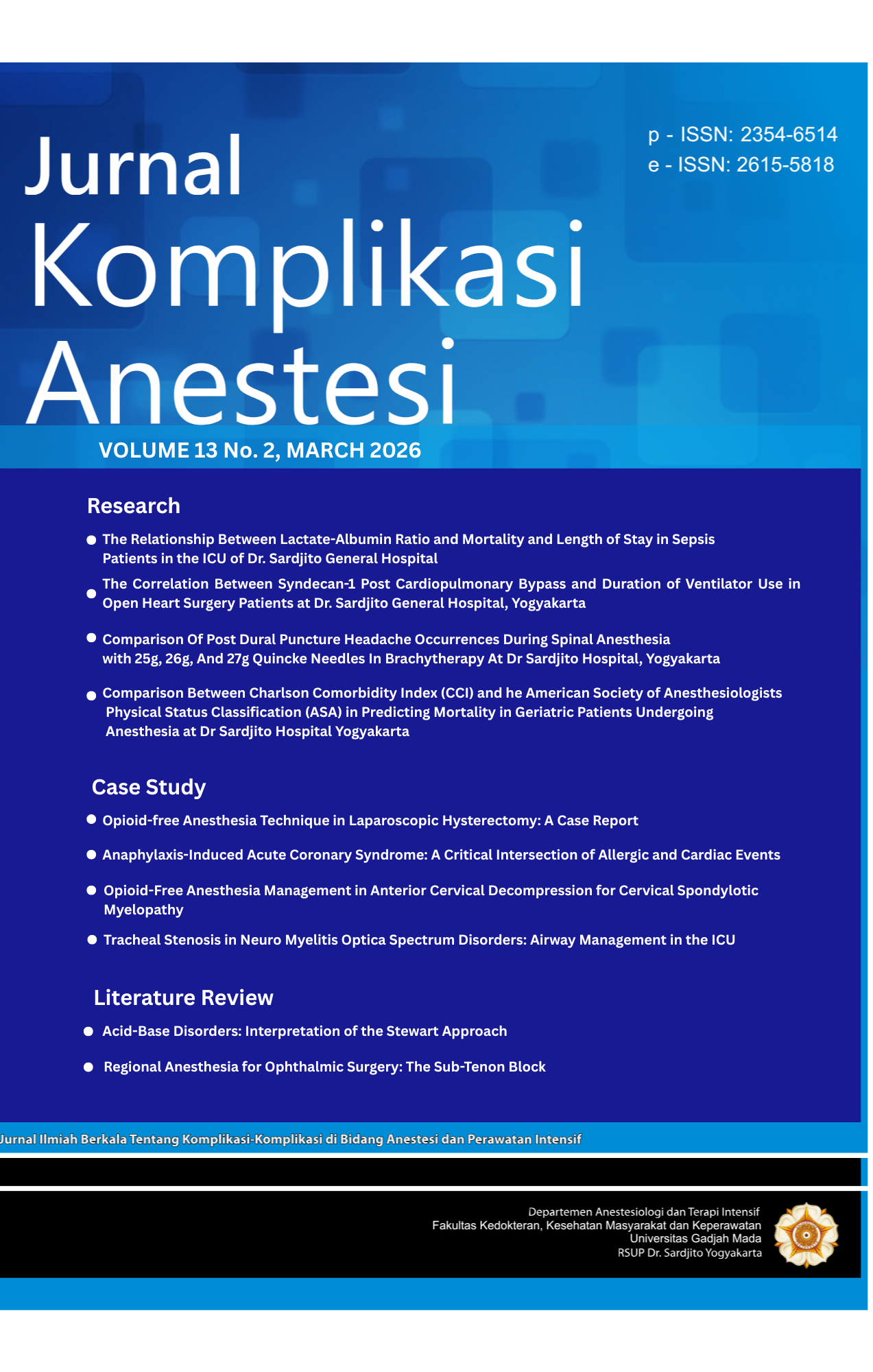
Acid-Base Disorders: Interpretation of the Stewart Approach
DOI:
https://doi.org/10.22146/jka.v13i2.28907Keywords:
acid-base disorder, Stewart approach, blood gas analysisAbstract
Comprehension of physiological consequences arising from acid-base disturbances, together with manageable factors such as ventilation and perfusion that rapidly affect acid-base balance, is essential for anesthesiologists. The application of the Stewart acid-base model has advanced the mechanistic understanding of acid-base physiology. This model incorporates shifts in ions, including Cl-, K+, Na+, and PO43-, as well as the buffering capacity of albumin, to detect acid-base disorders. The Stewart approach is superior for identifying subtle and otherwise undetectable metabolic changes. It is founded on three core principles: electroneutrality, dissociation equilibria of incompletely dissociated substances, and mass conservation. In the Stewart method, [HCO3-] and pH in body fluids represent dependent variables determined by three independent variables: total CO2, strong ion difference (SID), and total weak non-volatile acid concentration (ATOT), which is primarily governed by albumin and phosphate levels.
References
Wolf MB. Physicochemical properties of abnormal blood acid-base buffering. J Appl Physiol. 2023;134(1):172–80. Doi: 10.1152/japplphysiol.00309.2022
Rubin DM. Stewart’s approach to quantitative acid-base physiology should replace traditional bicarbonate-centered models. J Appl Physiol. 2021;130(6):2019–21. Doi: https://doi.org/10.1152/japplphysiol.00042.2021
Brussee P, Zwaag J, van Eijk L, van der Hoeven JG, Moviat MA, Pickkers P, et al. Stewart analysis unmasks acidifying and alkalizing effects of ionic shifts during acute severe respiratory alkalosis. J Crit Care. 2021;66:1–5. Doi: https://doi.org/10.1016/j.jcrc.2021.07.019
Paliwal R, Pakavakis A, Divatia JV, Kulkarni AP. Utility of Stewart’s approach to diagnose missed complex acid-base disorders as compared to bicarbonate-anion gap based methodology in critically Ill patients: An observational study. Indian J Crit Care Med. 2022;26(1):23–32. Doi: 10.5005/jp-journals-10071-24077
Reddi AS. Methods to assess acid-base disorders. In: Clinical evaluation and management acid-base disorders. Springer; 2020, 403–19.
Imenez Silva PH, Mohebbi N. Kidney metabolism and acid–base control: back to the basics. Pflugers Arch. 2022;474(8):919–34. Doi: 10.1007/s00424-022-02696-6
Habibzadeh F, Yadollahie M, Habibzadeh P. Introduction to acid-base chemistry and arterial blood gases. In: Pathophysiologic basis of acid-base disorders. Springer; 2021, 71-82.
Pierre D. A systematic approach to ABG Interpretation. In: Ranson M, Pierre D, editors. Arterial Blood Gas Interpretation A Case Study Approach. M&K Publishing. 2016.
Van Regenmortel N, Rosseels W, Elbers PWG. Acid-Base issues in fluid therapy. In: Joosten A, Cannesson M, Hahn RG, editors. Hemodynamic monitoring and fluid therapy during surgery. Cambridge University Press. 2024.
Sadiq S, Ijaz A, Hussain M. Establishing correlation of pH with various physiochemical and traditional parameters of acid base balance: A cross-sectional study. Khyber Med Univ J. 2022;14(2):104–9. Doi: https://doi.org/10.35845/kmuj.2022.21588
Ghosh S. Acid base homeostasis: Stewart approach at the bedside. In: Malbrain MLNG, Wong A, Nasa P, Ghosh S, editors. Rational use of intravenous fluids in critically Ill patients. Springer International Publishing. 2024.
Priya PV, Jayakumar KP, Kurien A, Thomas PC. Acid base disturbances in leptospirosis patients: Comparison of conventional and Stewart method. Natl J Physiol Pharm Pharmacol. 2023;(0):1.
George YW. Easy Way to Understand Stewart’s Acid-Base. 2015. Doi: DOI:10.5455/njppp.2023.13.07346202320112023
Magder S, Magder A, Samoukovic G. Intracellular pH regulation and the acid delusion. Can J Physiol Pharmacol [Internet]. 2021; 99(6):561–76. Available from: https://cdnsciencepub.com/doi/10.1139/cjpp-2020-0631
Kilic O, Gultekin Y, Yazici S. The Impact of Intravenous Fluid Therapy on Acid Base Status of Critically Ill Adults: A Stewart Approach-Based Perspective. Int J Nephrol Renovasc Dis. 2020;13:219–30. Doi: 10.2147/IJNRD.S266864
Cole DJ, Schlunt M. Adult perioperative anesthesia - The requisites in anesthesiology. Ch 7. Elsevier Australia, 2004, 165.
Downloads
Published
How to Cite
Issue
Section
License
The Contributor and the company/institution agree that all copies of the Final Published
Version or any part thereof distributed or posted by them in print or electronic format as permitted herein will include the notice of copyright as stipulated in the Journal and a full citation to the Journal.