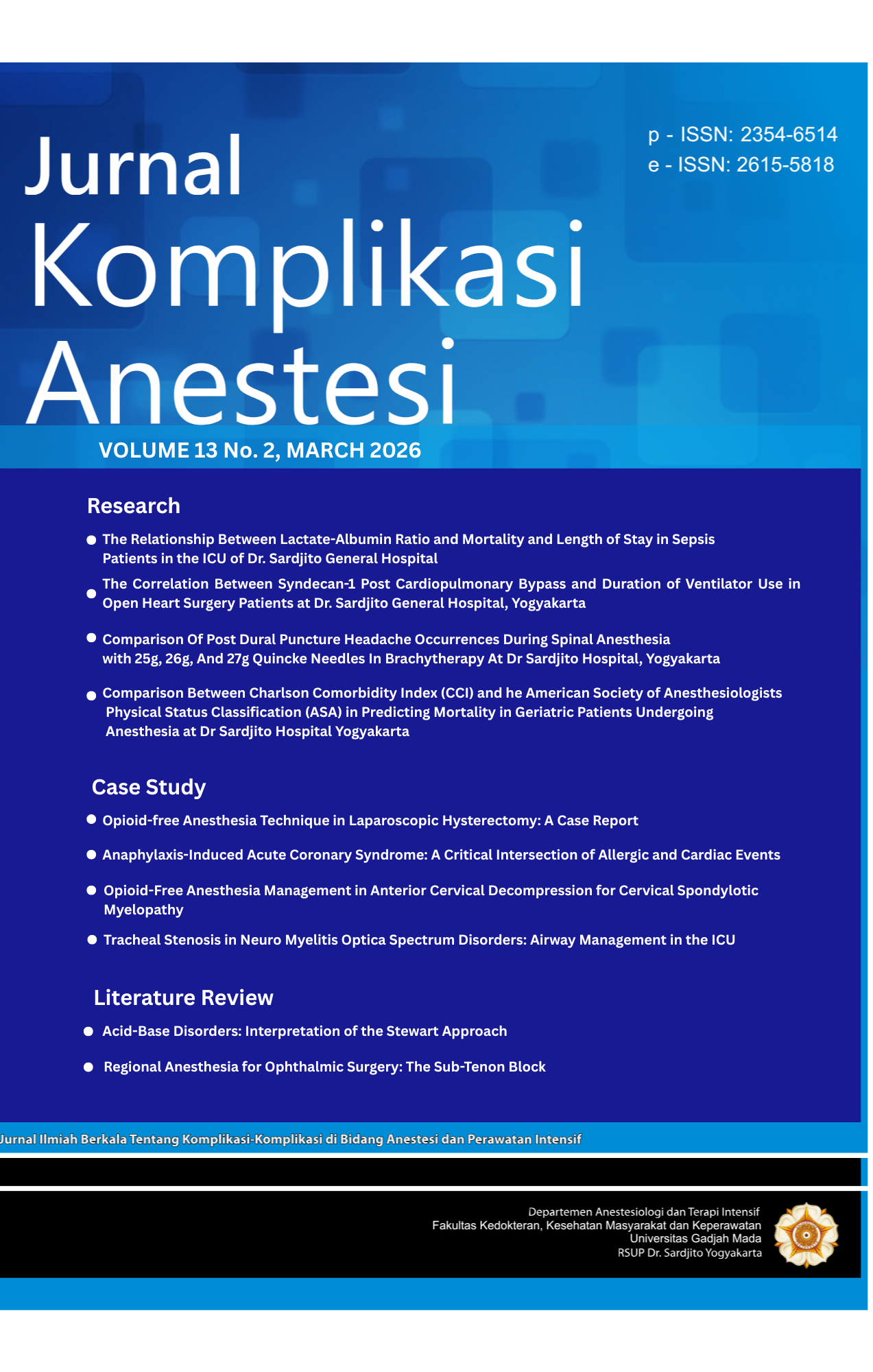
The Correlation Between Syndecan-1 Post Cardiopulmonary Bypass and Duration of Ventilator Use in Open Heart Surgery Patients at Dr. Sardjito General Hospital, Yogyakarta
DOI:
https://doi.org/10.22146/jka.v13i2.29233Keywords:
Cardiopulmonary bypass (CPB), endothelial glycocalyx, syndecan-1, ventilatorAbstract
Background: Open heart surgery involves the use of a cardiopulmonary bypass machine (CBP) to replace the heart and lungs during surgery. The use of CBP can damage the endothelial glycocalyx, which triggers increased levels of syndecan-1, an indicator of endothelial degradation. Elevated syndecan-1 levels are associated with various complications, such as coagulation disorders, edema, and organ dysfunction. In the lungs, endothelial glycocalyx damage can lead to edema and lung parenchymal damage, which can impair overall lung function and lead to a decreased PaO2/FiO2 ratio, requiring prolonged postoperative ventilator use.
Objective: This study aimed to determine the relationship between post-CBP syndecan-1 levels and the duration of ventilator use in open heart surgery patients at Dr. Sardjito General Hospital, Yogyakarta.
Methods: This study was a prospective, analytical, observational cohort study conducted at Dr. Sardjito General Hospital, Yogyakarta. The sample consisted of adult patients undergoing open heart surgery, with the exclusion criteria being patients using preoperative mechanical assist devices. Syndecan-1 levels were measured using the ELISA method using the Elabscience Human SDC1 kit. Data were analyzed using SPSS. Bivariate and multivariate analyses were also performed to evaluate factors influencing ventilator duration.
Results: The study was conducted on 34 subjects with a mean age of 46 ± 13.71 years. The average CPB duration was 92.94 ± 47.57 minutes, with preoperative syndecan-1 levels of 8.86 ± 5.08 ng/ml, while post-CPB levels were 11.74 ± 3.71 ng/ml, with delta syndecan-1 levels of 2.87 ± 4.18 ng/ml.
References
Puruhito. Ilmu Bedah Toraks, Kardiak, dan Vaskular. Airlangga University Press. 2013, 1-180.
Knežević D, Ćurko-Cofek B, Batinac T, Laškarin G, Rakić M, Šoštarič M, et al. Endothelial dysfunction in patients undergoing cardiac surgery: a narrative review and clinical implications. J Cardiovasc Dev Dis. 2023;10(5):213. Doi: 10.3390/jcdd10050213
Wiguna Y, Setiawan P, Semedi BP, Purwanto B. Syndecan-1 laktat dan profil lipid sebagai faktor risiko keparahan dan mortalitas sepsis. J Anestesi Perioper. 2021;9(1):18–26. Doi: https://doi.org/10.15851/jap.v9n1.2251
Adil A, Setiawan P, Sembiring YE, Budiono. Correlation between elevated TNF- α, Syndecan-1, and Urine IL-18 levels in acute kidney injury following on pump cardiac surgery. Crit Care Shock. 2021; 24(1):23-31
Kajita Y, Terashima T, Mori H, Islam MdM, Irahara T, Tsuda M, et al. A longitudinal change of syndecan-1 predicts risk of acute respiratory distress syndrome and cumulative fluid balance in patients with septic shock: a preliminary study. J Intensive Care. 2021;9(1):1-9. Doi: 10.1186/s40560-021-00543-x
Marhana IA, Rampengan VRC, Abbas KA. Syndecan-1 as a predictive biomarker for lung injury in mechanically ventilated pneumonia patients: a cross-sectional study. J Adv Pharm Educ Res. 2025;15(3):148–56. Doi: . https://doi.org/10.51847/uSxDaZMb1R
Hahn RG, Zdolsek M, Krizhanovskii C, Ntika S, Zdolsek J. Elevated plasma concentrations of Syndecan-1 do not correlate with increased capillary leakage of 20% albumin. Anesth Analg. 2021;132(3):856–65. Doi: 10.1213/ANE.0000000000005315
Lestari MI, Gunawan F, Syukri E, Saleh I. Korelasi kadar hyaluronan dan syndecan-1 dengan angka mortalitas pasien sepsis yang dirawat di ICU. Maj Anesth Crit Care. 2017;35(2): 65-70.
Dekker NAM, Veerhoek D, Koning NJ, Van Leeuwen ALI, Elbers PWG, Van Den Brom CE, et al. Postoperative microcirculatory perfusion and endothelial glycocalyx shedding following cardiac surgery with cardiopulmonary bypass. Anaesthesia. 2019;74(5):609–18. Doi: 10.1111/anae.14577
Murphy LS, Wickersham N, McNeil JB, Shaver CM, May AK, Bastarache JA, et al. Endothelial glycocalyx degradation is more severe in patients with non-pulmonary sepsis compared to pulmonary sepsis and associates with risk of ARDS and other organ dysfunction. Ann Intensive Care. 2017;7(1):1-9. Doi: 10.1186/s13613-017-0325-y
Miranda DR, Gommers D, Papadakos PJ, Lachmann B. Mechanical ventilation affects pulmonary inflammation in cardiac surgery patients: The role of the open-lung concept. J Cardiothorac Vasc Anesth. 2007;21(2):279–84. Doi; 10.1053/j.jvca.2006.02.007
Gravlee GP, Shaw AD, Bartels K. Hensleys practical approach to cardiothoracic anesthesia. 6th ed. Philadelphia Wolters Kluwer. 2019, 1-31.
Saravi B, Goebel U, Hassenzahl LO, Jung C, David S, Feldheiser A, et al. Capillary leak and endothelial permeability in critically ill patients: a current overview. 2023; 11(96): 1-21. Doi: https://doi.org/10..1186/s40635-023-00582-8
Lin L, Niu M, Gao W, Wang C, Wu Q, Fang F, et al. Predictive role of glycocalyx components and MMP-9 in cardiopulmonary bypass patients for ICU stay. Heliyon. 2024;10(1):1-10. Doi: 10.1016/j.heliyon.2023.e23299
He G, Gao Y, Feng L, He G, Wu Q, Gao W, et al. Correlation Between Wall Shear Stress and Acute Degradation of the Endothelial Glycocalyx During Cardiopulmonary Bypass. J Cardiovasc Trans Res. 2020;13(6):1024–32. Doi: 10.1007/s12265-020-10027-2
Kim HB, Soh S, Kwak YL, Bae JC, Kang SH, Song JW. High preoperative serum syndecan-1, a marker of endothelial glycocalyx degradation, and severe acute kidney injury after valvular heart surgery. J Clin Med. 2020;9(6):1-12. Doi: 10.3390/jcm9061803
Schønemann-Lund M, Itenov TS, Larsson JE, Lindegaard B, Johansson PI, Bestle MH. Endotheliopathy is associated with slower liberation from mechanical ventilation: a cohort study. Crit Care. 2022;26(1):1-15. Doi; 10.1186/s13054-021-03877-y
Nicolotti D, Grossi S, Nicolini F, Gallingani A, Rossi S. Difficult respiratory weaning after cardiac surgery: a narrative review. J Clin Med. 2023;12(2):1-13.
Kermani MS, Dehesh T, Pouradeli S, Esmaili BS. Factors affecting the prolongation of mechanical ventilation in patients after cardiac surgery. J Cardiothorac Surg. 2025;20(104):1-9. Doi; https://doi.org/10.1186/s13019-024-03247-z
Sankar A, Rotstein AJ, Teja B, Carrier FM, Belley-Côté EP, Bolliger D, et al. Prolonged mechanical ventilation after cardiac surgery: substudy of the Transfusion Requirements in Cardiac Surgery III trial. Can J Anesth. 2022;69(12):1493–506. Doi: 10.1007/s12630-022-02319-9.
Yang H, Kong L, Lan W, Yuan C, Huang Q, Tang Y. Risk factors and clinical prediction models for prolonged mechanical ventilation after heart valve surgery. BMC Cardiovasc Disord. 2024;24(1):1-11. Doi: https://doi.org/10.1186/s12872-024-03923-x
Michaud L, Dureau P, Kerleroux B, Charfeddine A, Regan M, Constantin JM, et al. Development and validation of a predictive score for prolonged mechanical ventilation after cardiac surgery. J Cardiothorac Vasc Anesth. 2022;36(3):825–32. Doi: https://doi.org/10.1053/j.jvca.2021.07.016
Erol M, Tenekecigil A, Ozel A, Bostan Gayret O, Yuce O, et al. Elevated serum syndecan-1 levels are associated with obesity-related complications in children. Iran J Pediatr [Internet]. 2025;35(1):e148999. Published 2024 Oct 16 [cited 2025 Dec 10]. Available from: https://brieflands.com/journals/ijp/articles/148999
Downloads
Published
How to Cite
Issue
Section
License
The Contributor and the company/institution agree that all copies of the Final Published
Version or any part thereof distributed or posted by them in print or electronic format as permitted herein will include the notice of copyright as stipulated in the Journal and a full citation to the Journal.