






- Focus and Scope
- Section Policies
- Peer Review Process
- Publication Frequency
- Open Access Policy
- Archiving
- Advertising Policy
- Direct Marketing
- AI Policy
- Reviewer Guidelines
- Editor Guidelines
- Authorship and Co-authorship
- Post-publication Discussion
- Ownership and Management
- Ethical Approval and Informed Consent
Focus and Scope
Journal of Community Empowerment for Health is dedicated to the publication of high-quality, innovative research that advances the science and practice of community-led health initiatives, public health, and health equity. The journal provides a multidisciplinary platform for scholars, field practitioners, and policymakers to critically analyze, evaluate, and disseminate evidence-based interventions that empower local communities to improve their health and well-being.
While Journal of Community Empowerment for Health focuses primarily on the Indonesian context, reflecting its unique socio-cultural diversity, rural health challenges, and community dynamics, we welcome comparative and empirical contributions from communities worldwide that offer global relevance and transferable insights.
Submitted articles may encompass a broad spectrum of interdisciplinary public health domains, provided they focus on empowering communities and strengthening community health systems. Core thematic areas include, but are not limited to:
- Community Empowerment & Health Promotion: Community-led health models, participatory action research, health literacy, advocacy, and social mobilization.
- Rural & Primary Community Health: Primary healthcare access, social medicine, epidemiology, occupational health in rural settings, and community service interventions.
- Multidisciplinary & Intersectoral Approaches: Medical anthropology, health economics, environmental health, and collaborative interprofessional health solutions.
- Community-Based Education: Field-based medical and public health education, community training programs, and capacity-building frameworks.
- Disaster Response & Resilience: Community preparedness, disaster medicine, crisis management, and post-disaster health rehabilitation.
Types of Manuscripts Accepted
In alignment with national accreditation standards and international publication ethics, Journal of Community Empowerment for Health prioritizes high impact original research articles (empirical studies using quantitative, qualitative, or mixed-methods approaches). To maintain scientific rigor, other manuscript types including systematic reviews, scoping reviews, policy briefs, and community case reports, are accepted on a selective basis provided they deliver significant novelty and a strong critical discussion. Editorials are published by invitation only. All submissions must comply strictly with JCOEMPH's Publication Ethics and Author Guidelines.
Section Policies
Editorial
 Open Submissions |
Indexed |
Peer Reviewed |
Original Research Articles
| Open Submissions |
Indexed |
Peer Reviewed |
Case Study Articles
| Open Submissions |
Indexed |
Peer Reviewed |
Review Articles
| Open Submissions |
Indexed |
Peer Reviewed |
Policy Articles
| Open Submissions |
Indexed |
Peer Reviewed |
Peer Review Process
Peer Review Process
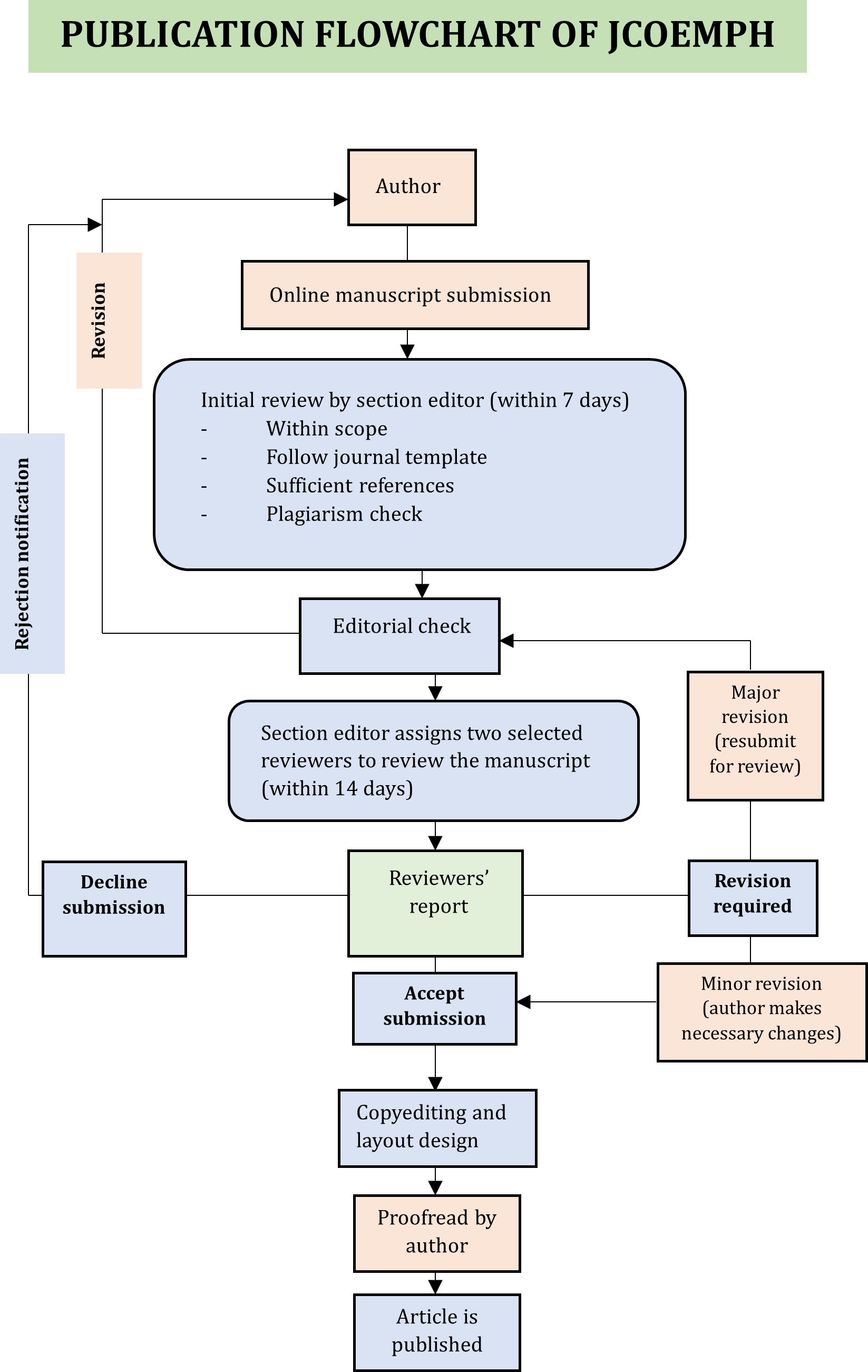
Every manuscript submitted has to follow the author guidelines of JCOEMPH. Every article will go through Initial Review processes by section editors. It will be evaluated whether it is suitable with our focus and scope or has a major methodological flaw. Every submitted manuscript which pass this step will be checked to identify any plagiarism before being reviewed by reviewers.
Articles meet the above mentioned requirements will go through Double-Blind Peer Review Process by at least 2 (two) or more Peer-Reviewers. Once the review is completed, the articles will be returned to the authors along with reviewers’ evaluation. Authors have to revise accordingly within two weeks after notification email from editor. In addition to revised paper, authors have to respond to all the reviewers’ comments in separate file. These processes might take three months for maximum time.
In each manuscript evaluation, the peer reviewer will be rated on the substantial and technical aspects. The final decision is made by Editor-in-Chief by considering evaluation given by a section editor and reviewers. All accepted manuscripts will be proofread by JCOEMPH and author before being published.
Types of Decision:
- Decline submission: Following peer review, the journal will not publish the paper. Editor sends rejection notice and invitation to revise and resubmit as a new article
- Resubmit for review: The journal is willing to reconsider the paper in another round of peer review after the authors make major changes
- Revisions required: The paper requires changes before a final decision can be made. Authors are asked to revise their manuscript based on reviewers’ and editors’ comments and submit a revised version within 2 weeks. A point-by-point explanation of how comments have been addressed must be supplied with the revised version of the paper. Revisions may undergo further peer review and papers may undergo more than one round of revision. If the authors do not revise their papers to the satisfaction of the editors, the paper can still be declined from publication in JCOEMPH
- Accept submission: The journal will publish the paper provided the authors make the changes suggested by the reviewers and/or editors. The paper is accepted for publication, subject to conditions that need to be addressed in producing a final version of the manuscript. These may include sub-editing changes and the minor amendment to ensure the paper fully matches our criteria. After final checking in the editorial office, acceptance is confirmed and the paper is forwarded to the publishers for publication.
Publication Frequency
Journal of Community Empowerment for Health published three times a year (April, August, and December).
Open Access Policy
Articles published under Journal of Community Empowerment for Health (JCOEMPH) are made freely available online immediately upon publication, without subscription barriers to access. In addition, it will allow readers to reuse, republish or distribute the article in various ways or use them for any other lawful purpose.
Archiving
This journal utilizes the PKP PN system and internet archive to create a distributed archiving system among participating libraries and permits those libraries to create permanent archives of the journal for purposes of preservation and restoration.
Advertising Policy
Journal of Community Empowerment for Health does not receive an advertisement
- Journal of Community Empowerment for Health sets high ethical standards in all its activities and, above all, defends the right to editorial independence. It does not allow advertising or sponsorship to influence the decisions made on editorial content.
- Readers understand that advertising is different from editorial material. They know that the claims made in advertising are not endorsed by Journal of Community Empowerment for Health.
- Journal of Community Empowerment for Health will carry advertisements that are legal and decent and conform to current recommendations and guidelines.
- Decisions on the positioning of advertisements are made independently of decisions made in the editorial department on the content of a specific issue.
- Editorial material will not be influenced by advertising. Journal of Community Empowerment for Health does not publish material to accompany advertising and does not sell advertising in relation to particular articles.
- All decisions are at the discretion of the editor. If commercial clients adhere to these guidelines then their advertisement or sponsorship is likely to be accepted. Occasionally decisions may take time.
Direct Marketing
We invite authors to submit manuscripts to our journal through official announcements on the journal's website and social media, communication through associations, and personal communication with authors who have expertise in accordance with the objectives and scope of our journal.
We do not offer fast publication, fast reviews, or acceptance guarantees. We also do not aggressively or recklessly invite anyone to submit articles to our journal.
AI Policy
The Journal of Community Empowerment for Health recognizes that artificial intelligence (AI) and AI-assisted technologies may support certain aspects of academic writing and editorial work. However, their use must be consistent with the principles of research integrity, transparency, confidentiality, and accountability.
This policy establishes the requirements for the use of AI tools by authors, editors, and reviewers to ensure that AI supports, rather than replaces, human expertise and responsibility in scholarly publishing.
1. Policy on the Use of AI by Authors
1.1. Authorship and Responsibility
AI tools, including generative AI systems and large language models, cannot be listed as authors or co-authors. Authorship requires human accountability for the accuracy, integrity, originality, and ethical conduct of the work.
Authors remain fully responsible for all content submitted to JCOEMPH, including text, data, analyses, tables, figures, references, and other materials generated or assisted by AI tools. Authors must critically review and verify all AI-assisted content before submission.
1.2. Permitted Uses of AI
AI tools may be used to support limited aspects of manuscript preparation, including:
- Improving grammar, spelling, language, and readability
- Assisting with language translation and sentence refinement.
- Supporting brainstorming and preliminary outlining, provided that the final scholarly arguments and interpretations are developed and validated by the authors.
- Assisting with data processing, statistical analysis, or visualization, provided that the methods are scientifically appropriate, reproducible, and independently verified by the authors.
- Supporting literature organization or summarization, provided that all sources are checked against the original publications and cited appropriately.
The use of AI must not compromise the originality, scientific validity, or ethical standards of the manuscript.
1.3. Disclosure of AI Use
Authors must disclose the use of generative AI or AI-assisted technologies that contribute to manuscript preparation or research activities.
The disclosure should identify:
- The name of the AI tool and, where available, its version.
- The purpose of its use.
- The relevant sections or research activities in which it was used.
- The extent of human review and verification.
Suggested statement:
“The authors used [name of AI tool] for [specific purpose] during the preparation of this manuscript. The AI-assisted content was critically reviewed and verified by the authors, who take full responsibility for the accuracy, originality, and integrity of the final manuscript.”
If no AI tools were used, authors may state:
“The authors declare that no generative AI tools were used in the preparation of this manuscript.”
1.4. Prohibited Uses of AI
AI tools must not be used to:
- Fabricate, manipulate, or falsify research data, findings, images, or references.
- Generate false citations or present unverified information as established evidence.
- Replace the authors' responsibility for research design, scientific interpretation, or conclusions.
- Present AI-generated content as original human work without appropriate disclosure.
- Create or manipulate images in ways that misrepresent research findings or evidence.
- Violate participant confidentiality, data protection requirements, intellectual property rights, or research ethics.
- Generate misleading accounts of community empowerment activities, participant involvement, research procedures, or program outcomes.
Editors must exercise independent professional judgment when assessing manuscripts and making editorial decisions.
Editors must not upload unpublished manuscripts, reviewer reports, author correspondence, or other confidential editorial materials to public or unauthorized AI platforms.
AI tools must not replace an editor's independent assessment of a manuscript's originality, methodological rigor, ethical compliance, relevance to the journal's scope, or suitability for publication.
AI may be used for limited administrative or language-related assistance, such as improving the clarity of editorial correspondence, provided that confidentiality is protected and the final communication and decisions remain under human control.
Editors remain fully accountable for editorial decisions and must disclose any AI use when required by the journal's internal procedures.
3. Policy on the Use of AI by Reviewers
Peer review at JCOEMPH must be based on the reviewer's own expertise, critical assessment, and independent professional judgment.
Reviewers must not upload submitted manuscripts, supplementary files, reviewer comments, or other confidential materials to public or unauthorized AI systems.
Reviewers must not delegate the scientific evaluation of a manuscript to AI tools, including the assessment of research validity, methodology, interpretation, originality, ethical compliance, or publication recommendations.
AI may be used for limited language editing or grammar correction of a review report, provided that the manuscript's confidential content is not disclosed and the reviewer independently verifies the final report. Such use must not replace the reviewer's own scientific assessment.
Reviewers remain responsible for the accuracy, fairness, confidentiality, and integrity of their reviews.
4. Editorial Screening and Policy Compliance
JCOEMPH may conduct editorial checks to assess compliance with this policy. Any indication of inappropriate AI use will be evaluated by the Editorial Team based on the available evidence and the circumstances of the case.
AI-detection tools, where used, will not be treated as the sole basis for an editorial decision because their results may be inaccurate or inconclusive. Further clarification or supporting information may be requested from the authors when necessary.
Failure to comply with this policy may result in appropriate editorial action, including a request for clarification or revision, rejection of a submitted manuscript, or, in cases involving published articles, correction or retraction in accordance with the journal's publication ethics procedures.
Serious or suspected misconduct may be referred to the relevant institution or authority when appropriate.
5. Guiding Principles
The use of AI at JCOEMPH must be guided by the following principles:
- Transparency: AI use must be disclosed when required by this policy.
- Human accountability: Authors, editors, and reviewers retain responsibility for their respective work and decisions.
- Research integrity: AI must not be used to fabricate, falsify, or misrepresent research.
- Confidentiality: Unpublished manuscripts and sensitive information must be protected.
- Ethical responsibility: AI use must respect research participants, communities, intellectual property, and applicable ethical requirements
Reviewer Guidelines
Duties of Reviewers
Core Expectations for Reviewers
- Fair & Impartial Evaluation: Every manuscript must be assessed purely on its scientific merit, conceptual rigor, and contribution to knowledge, without regard to the authors' background, gender, nationality, or institutional affiliation.
- Strict Confidentiality: Submitted papers are privileged intellectual property. Reviewers must not circulate, duplicate, retain, or discuss any part of the manuscript with outside parties.
- Prohibition of AI Tools: Reviewers are strictly forbidden from uploading manuscripts (or any part thereof) into Generative AI tools, Large Language Models (LLMs), or online processing software. Review reports must be generated solely through the reviewer's independent expert analysis.
- Conflict of Interest Management: Reviewers must immediately disclose any potential personal, academic, or financial conflicts of interest to the Editor-in-Chief and withdraw from the evaluation process.
- Timely & Professional Reporting: Reviews should be delivered within the agreed timeframe (2 to 3 weeks) and written in a constructive, objective, and polite manner.
- Reporting Misconduct: Any evidence of text overlap, data manipulation, missing ethical approvals, or duplicate submissions must be reported directly to the Editorial Board.
All submissions to the Journal of Community Empowerment for Health undergo a rigorous double-blind peer review. This process ensures that published research aligns with the journal's scope, including community empowerment, rural community health, health multidisciplinary approach, community-based education, health promotion, and disaster response, while maintaining high standards of academic rigor.
We view the peer review process as a collaborative endeavor aimed at nurturing high-quality scientific literature. Reviewers are encouraged to provide actionable feedback that helps researchers, especially early-career scholars and field practitioners, refine their methodologies and articulate their findings clearly.
Comments must remain respectful and encouraging at all times. Intimidating, derogatory, or unconstructive remarks are unacceptable and may lead to a reviewer's removal from the journal's reviewer pool.
Ethics & Reviewer Conduct
Reviewers hold a trusted position in safeguarding research integrity. As a reviewer for JCOEMPH, you agree to:
- Treat all manuscript files, communication, and review records as strictly confidential.
- Refrain from using any unpublished data or insights from the manuscript for personal research or commercial advantage.
- Preserve the integrity of the double-blind review system by avoiding any attempt to contact authors directly.
- Refrain from feeding manuscript text into AI applications to safeguard intellectual property and confidentiality.
When evaluating a manuscript for JCOEMPH, reviewers should examine the following aspects:
Focus & Scope: Alignment with community empowerment, rural health, health promotion, epidemiology, and disaster response.
Originality & Research Gap: Clear state-of-the-art overview, explicit gap analysis, and well-defined research objectives.
Methodology & Ethical Approval: Sound research design, clear protocols, and mandatory Ethical Clearance details for studies involving human or animal subjects.
Discussion & Literature: Critical analysis comparing findings with recent primary sources (minimum 80% primary, 80% published within the last 10 years).
Data & Presentation: Logical flow, clear scientific English, proper tables/figures, and precise, non-manipulated references.
Reviews are managed through the OJS portal within a 2- to 3-week timeline. Reviewers provide narrative feedback for authors and select a final recommendation:
- Accept Submission: Ready for publication without changes.
- Revisions Required: Minor adjustments needed before acceptance.
- Resubmit for Review: Major substantive revisions requiring a second review round.
- Decline Submission: Lacks novelty, scientific quality, ethical approval, or relevance to JCOEMPH.
Editor Guidelines
- Editorial Independence: Editors’ decisions to accept or reject a manuscript for publication must be based solely on the paper’s scientific quality, originality, clarity, empirical rigor, and its direct relevance to JCOEMPH’s focus and scope. Decisions must never be influenced by financial, commercial, institutional, or publisher pressures.
- Strict Confidentiality: Editors must treat all submitted manuscripts, peer-review reports, and editorial communications as strictly confidential documents.
- Managing Misconduct & Ethical Breaches: Editors must take all allegations of research misconduct—including plagiarism, data fabrication, falsification, duplicate submission, and invalid authorship—seriously and investigate them following COPE flowcharts.
- Enforcing Ethical Clearance: Editors must verify that all empirical studies involving human participants, community interventions, or sensitive field data cite a valid Ethical Clearance number and approving committee.
- Promoting Cultural Sensitivity: Editors should exercise appropriate sensitivity when publishing images, narratives, or field data that carry cultural significance or could cause offense within local communities.
- Ensuring AI Transparency: Editors must enforce the journal's AI Policy, ensuring that any AI usage by authors is transparently disclosed. Editors must strictly ensure that peer reviewers do not upload submitted manuscripts into Generative AI applications or LLMs.
- Handling Conflict of Interest: Editors should encourage peer reviewers to decline review invitations immediately if a personal, financial, or collaborative conflict of interest exists. Editors must also recuse themselves from handling manuscripts where their own impartiality might be compromised.
- Reviewer Selection: Editors may consider reviewer suggestions made by authors but are under no obligation to use them.
- Managing Review Correspondence: Editors must mediate all communications between authors and reviewers during the peer-review process to maintain double-blind anonymity. If a consensus cannot be reached, editors may invite additional reviewer(s) to evaluate the manuscript.
- Post-Publication Corrective Actions: Editors must promptly publish Errata, Corrections, or Retractions upon discovering serious errors or confirmed academic misconduct that affect data interpretation.
- Preserving Reviewer Anonymity: Editors must protect peer reviewers’ identities. If identities are accidentally revealed, editors should discourage authors from contacting reviewers directly.
- Timely Editorial Processing: Editors should ensure a prompt, fair, and rigorous peer-review and publication process. Editors are strictly prohibited from promising fast-track acceptance or issuing Letters of Acceptance (LoA) prior to formal manuscript acceptance.
Overview & Editorial Responsibilities
The Editorial Board of Journal of Community Empowerment for Health bears ultimate responsibility for deciding which submitted manuscripts will be published. All editorial decisions are guided by academic integrity, COPE Principles, and national accreditation standards.
- Editorial Decision-Making & Independence: Editors evaluate submissions purely on their academic merit, methodological soundess, and alignment with JCOEMPH's scope in community health, rural healthcare, health promotion, and disaster response. No editorial choice shall be dictated by commercial interests, organizational relationships, or institutional affiliations.
- Integrity of the Double-Blind Peer Review: Editors oversee the double-blind peer-review workflow. They ensure that each manuscript is evaluated by at least two qualified reviewers with appropriate subject expertise and verified publication track records. Editors ensure that reviewers provide substantive comments on study design, gap analysis, and discussion rather than superficial formatting feedback.
- Ethical Oversight & Post-Publication Accountability: Editors actively safeguard research ethics. In cases of suspected misconduct, editors will initiate a transparent investigation. If errors or ethical breaches are substantiated after publication, editors will issue appropriate notices (Correction, Erratum, or Retraction) linked directly to the article's DOI and metadata.
Authorship and Co-authorship
Authorship credit must be limited strictly to individuals who have made substantial direct intellectual contributions to the conception, execution, or interpretation of the reported study. To qualify as an author or co-author, each individual must meet all four basic criteria:
- Substantial contributions to the study's design, field data collection, or data analysis;
- Drafting the manuscript or critically revising it for important intellectual content;
- Final approval of the version to be published; and
- Agreement to be accountable for all aspects of the work in ensuring that questions related to the accuracy or integrity of any part are appropriately investigated and resolved.
Artificial Intelligence (AI) tools, Large Language Models (LLMs), or processing software platforms cannot be listed or cited as an author or co-author. Authorship carries legal, ethical, and academic responsibilities that can only be attributed to and fulfilled by human researchers. Any use of AI tools for language editing or technical refinement must be transparently disclosed in the manuscript's Methods or Declarations section. Authors are required to submit an Author Contribution Statement specifying the individual roles of each author at the time of initial submission.
Any request to modify the authorship list—including adding, removing, or reordering authors after submission—must be agreed upon by all co-authors. Such requests must be supported by a formal written explanation signed by all authors and submitted to the Editor-in-Chief for evaluation. Unjustified addition of authors after manuscript acceptance is strictly prohibited under national accreditation standards.
Gift, ghost, guest, or honorary authorship is considered a severe violation of publication ethics and is strictly prohibited. Individuals who contributed to the study (such as providing administrative support, funding, or general field assistance) but do not fulfill all four authorship criteria must not be listed as authors; instead, they should be acknowledged in the Acknowledgments section with their written permission. Allegations of inappropriate authorship will be investigated rigorously following COPE flowcharts and may lead to manuscript rejection, institutional notification, or post-publication Retraction.
Post-publication Discussion
Journal of Community Empowerment for Health welcomes open scholarly debate, constructive critique, and scientific feedback from readers, field practitioners, researchers, and stakeholders regarding any published article.
- Submitting Letters to the Editor
Critical observations, scientific inquiries, or formal comments on published content may be submitted directly to the Editorial Office (jcoemph.fk@ugm.ac.id) as a Letter to the Editor. Following an initial editorial review, relevant submissions may be shared with the original authors for a formal reply and considered for publication to foster transparent scientific exchange - Corrections and Amendments
When genuine administrative errors, typographical mistakes, or minor data inaccuracies are identified in published articles, the Editorial Board will evaluate the issue. Where necessary, an Erratum or Corrigendum will be published and permanently cross-linked to the original paper's metadata and Digital Object Identifier (DOI) to preserve the accuracy of the scholarly record. - Ethical Allegations & Misconduct Procedures
If a published work is suspected of research misconduct, data fabrication, falsification, plagiarism, or invalid ethical clearance, JCOEMPH will initiate a transparent investigation adhering strictly to Committee on Publication Ethics (COPE) guidelines. The process may involve consultation with authors, institution ethics committees, and expert advisers. Depending on the severity of the findings, the Chief Editor may issue a Correction, an Expression of Concern, or a formal Retraction. - Open Access & Transparency Commitment
All post-publication notices including errata, expressions of concern, and retraction statements are made fully Open Access and linked directly to the original article. JCOEMPH is dedicated to resolving all post-publication issues in a prompt, unbiased, and transparent manner to protect academic integrity and public trust in community health literature.
Ownership and Management
Journal of Community Empowerment for Health is a peer-reviewed scholarly journal published under the institutional ownership and responsibility of the Faculty of Medicine, Public Health, and Nursing, Universitas Gadjah Mada (FK-KMK UGM), Indonesia.
Publisher and Journal Management
FK-KMK UGM provides the institutional, financial, and administrative framework necessary to support the journal's publication. The Editorial Board is fully responsible for editorial screening, double-blind peer-review management, editorial decisions, publication processing, and upholding the highest ethical and academic standards. Detailed information regarding the Editor-in-Chief, Editorial Board, Peer Reviewers, and administrative team is maintained transparently on the journal's official website.
Editorial Independence
Journal of Community Empowerment for Health strictly upholds complete editorial independence. All editorial decisions are determined solely by scientific merit, originality, empirical validity, clarity, and direct relevance to community empowerment and public health. Institutional affiliations, commercial considerations, personal relationships, or publisher pressures do not improperly influence editorial judgments.
Roles, Transparency, and Official Information
While the publisher maintains the structural and governance framework, the Editorial Board manages scholarly evaluation and publication workflows strictly within established ethical policies. Editors, reviewers, authors, and the publishing institution are expected to adhere to the journal’s ethical standards and COPE guidelines to foster transparent and accountable research communication. Any material changes regarding journal ownership or management arrangements will be updated publicly.
Official information regarding JCOEMPH's editorial team, publishing policies, and contact details is accessible at https://journal.ugm.ac.id/jcoemph
Ethical Approval and Informed Consent
All submitted manuscripts reporting research on human participants, community interventions, or sensitive field data must strictly comply with international ethical standards and include a dedicated Ethical Consideration section placed immediately before the References. For studies involving direct human engagement, authors must explicitly state that the research protocol was approved by an accredited Institutional Ethics Committee including the official committee name, Ethical Clearance certificate number, and approval date and confirm that written informed consent was formally obtained from all participants prior to data collection.
For research relying on secondary data, public databases, or open records without direct human interaction, authors must explicitly declare that no primary human involvement occurred and transparently cite all underlying data sources, including official repository URLs or database details. By enforcing these requirements, Journal of Community Empowerment for Health ensures participant safety, data privacy, and full compliance with national accreditation standards (Kepdirjensaintek No. 374/2026) and COPE Principles.
Journal of Community Empowerment for Health Indexed by:





Faculty of Medicine, Public Health and Nursing, Universitas Gadjah Mada
Jl. Farmako, Sekip Utara, Yogyakarta 55281, Indonesia
Sekretariat Bersama Jurnal Room, 2nd floor above IKM canteen
📧 jcoemph.fk@ugm.ac.id
 @jcoemph.journal
© 2026 Journal of Community Empowerment for Health