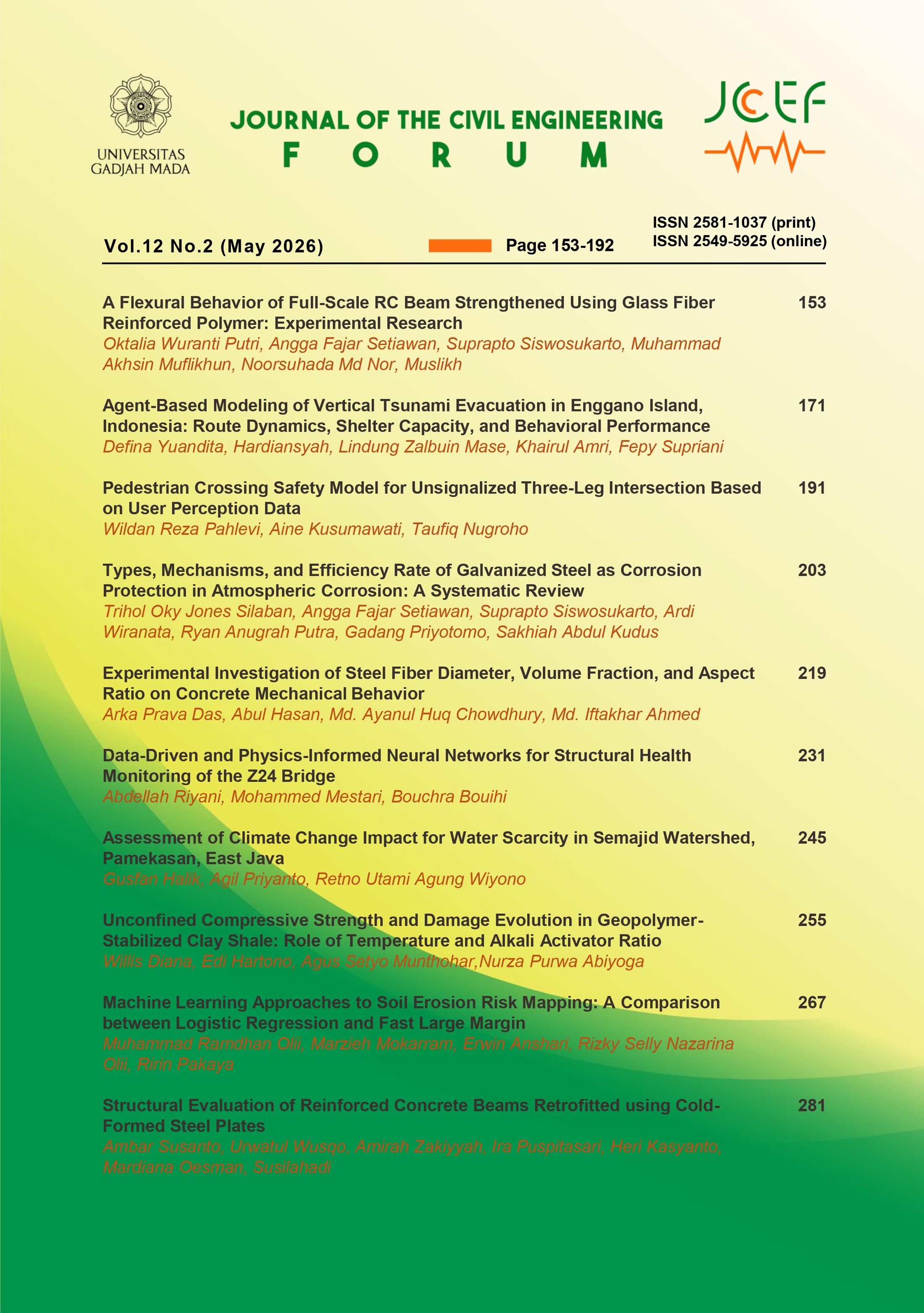
Unconfined Compressive Strength and Damage Evolution in Geopolymer-Stabilized Clay Shale: Role of Temperature and Alkali Activator Ratio
DOI:
https://doi.org/10.22146/jcef.22477Keywords:
Alkali Activator Ratio, Clay Shale, Damage Properties, Geopolymer Stabilization, TemperatureAbstract
Exposed clay shale is highly susceptible to weathering and rapid strength degradation, which often leads to slope and earth-structure instability. Geopolymer-based soil stabilization has emerged as a promising method to improve the mechanical properties of such problematic materials. However, this chemical stabilization process is sensitive to environmental conditions, particularly temperature fluctuations. The performance of geopolymer-stabilized clay shale under elevated-temperature conditions remains insufficiently investigated, particularly in tropical regions such as Indonesia, where temperatures can fluctuate between 25◦C and 40◦C, and the exposed ground surface may reach up to 60◦C during the dry season because of intense solar radiation. This study evaluates the effectiveness of fly ash–based geopolymer in stabilizing clay shale under temperature variations ranging from 26◦C to 60◦C. A series of laboratory experiments was conducted using two alkali activator ratios (Na2SiO3:NaOH), namely 2.0 (Ratio A) and 2.5 (Ratio B). Mechanical performance was assessed through unconfined compressive strength (UCS) tests, stress–strain analysis, and energy-based damage evolution to quantify strength development and failure behavior. The results indicate that temperature is the dominant factor controlling strength development. A 10◦C increase in curing temperature resulted in a 40–60% increase in UCS, whereas variations in the alkali activator ratio produced only a 15–20% increase. The highest strength amplification, reaching 16 times that of untreated soil, was achieved using Ratio B at 60◦C, while Ratio A showed strength stagnation above 50◦C. Microstructural observations suggest that elevated temperatures accelerate geopolymer gel formation, leading to higher initial stiffness and an expanded elastic region. However, this also resulted in more brittle behavior, characterized by a higher brittleness index and rapid post-peak damage propagation for Ratio B, whereas Ratio A exhibited greater ductility. Overall, higher curing temperatures increased the dissipated energy at failure and revealed a clear strength–ductility trade-off. These findings provide insights for optimizing geopolymer stabilization of clay shale, particularly for geotechnical applications in tropical environments where elevated in situ temperatures are common.
References
Abdullah, H. H., Shahin, M. A., Walske, M. L. and Karrech, A. (2020), ‘Systematic approach to assessing the applicability of fly-ash-based geopolymer for clay stabilization’, Canadian Geotechnical Journal 57, 1356–1368. URL: https://doi.org/10.1139/cgj-2019-0215
Abdullah, M., Ahmad, F. and Mustafa Al Bakri, A. (2015), ‘Geopolymer application in soil: A short review’, Applied Mechanics and Materials 754, 378–381. URL: https://doi.org/10.4028/www.scientific.net/AMM.754-755.378
Abdullah, M. M. A. B., Kamarudin, H., Bnhussain, M., Ismail, K. N., Rafiza, A. and Zarina, Y. (2011), ‘The relationship of naoh molarity, na2sio3/naoh ratio, fly ash/alkaline activator ratio, and curing temperature to the strength of fly ash-based geopolymer’, Advanced Materials Research 328, 1475–1482. URL: https://doi.org/10.4028/www.scientific.net/AMR.328-330.1475
Abdullah, M. S. and Ahmad, F. (2017), Effect of alkaline activator to fly ash ratio for geopolymer stabilized soil, in ‘MATEC Web of Conferences’, EDP Sciences, p. 01012. URL: https://doi.org/10.1051/matecconf/20179701012
Adhikari, S., Khattak, M. J. and Adhikari, B. (2020), ‘Mechanical characteristics of soil-rap-geopolymer mixtures for road base and subbase layers’, International Journal of Pavement Engineering 21(4), 483–496. URL: https://doi.org/10.1080/10298436.2018.149213
Aredes, F., Campos, T., Machado, J., Sakane, K., Thim, G. and Brunelli, D. (2015), ‘Effect of cure temperature on the formation of metakaolinite-based geopolymer’, Ceramics International 41, 7302–7311. URL: https://doi.org/10.1016/j.ceramint.2015.02.022
Ayub, F. and Khan, S. A. (2023), ‘An overview of geopolymer composites for stabilization of soft soils’, Construction and Building Materials 404, 133195. URL: https://doi.org/10.1016/j.conbuildmat.2023.133195
Bian, K., Liu, J., Zhang, W., Zheng, X., Ni, S. and Liu, Z. (2019), ‘Mechanical behavior and damage constitutive model of rock subjected to water-weakening effect and uniaxial loading’, Rock Mechanics and Rock Engineering 52, 97–106. URL: https://doi.org/10.1007/s00603-018-1580-4
Diana, W., Hartono, E. and Damayanti, I. (2025), The durability of clay-fly ash-based geopolymer: The variation on curing temperature, in ‘AIP Conference Proceedings’. URL: https://doi.org/10.1063/5.0280478
Diana, W., Hartono, E. and Kusuma, A. W. (2025), Optimizing strength in marine sand-fly ash geopolymers: The impact of alkali activator ratios and curing temperatures, in ‘Lecture Notes in Civil Engineering’, pp. 165–173. URL: https://doi.org/10.1007/978-981-96-2143-9_18
Diana, W., Ma’rifah, R. and Hartono, E. (2025), The tensile strength of marine sand using fly ash-based geopolymer: Influence of sodium hydroxide concentration and alkaline activator ratio, in ‘Journal of Physics: Conference Series’, IOP Publishing, p. 012038. URL: https://doi.org/10.1088/1742-6596/2989/1/012038
Duxson, P., Fernández-Jiménez, A., Provis, J. L., Lukey, G. C., Palomo, A. and Van Deventer, J. S. (2007), ‘Geopolymer technology: The current state of the art’, Journal of Materials Science 42, 2917–2933. URL: https://doi.org/10.1007/s10853-006-0637-z
Duxson, P. and Provis, J. L. (2008), ‘Designing precursors for geopolymer cements’, Journal of the American Ceramic Society 91, 3864–3869. URL: https://doi.org/10.1111/j.1551-2916.2008.02787.x
Gao, Y., Feng, Y., Tong, G. and Tang, X. (2021), Influences of sodium silicate modulus on mechanical properties and microstructure of fly ash geopolymer, in ‘IOP Conference Series: Earth and Environmental Science’, p. 012056. URL: https://doi.org/10.1088/1755-1315/760/1/012056
Ghadir, P. and Ranjbar, N. (2018), ‘Clayey soil stabilization using geopolymer and portland cement’, Construction and Building Materials 188, 361–371. URL: https://doi.org/10.1016/j.conbuildmat.2018.07.207
Hartono, E., Diana, W. and Bahti, F. N. (2023), Unconfined compressive strength test on geopolymer fly ash stabilized clay shale, in ‘E3S Web of Conferences’, Vol. 429, pp. 1–6. URL: https://doi.org/10.1051/e3sconf/202342904025
Hartono, E., Diana, W. and Hendriana, J. W. (2023), Study of compressive strength and durability of geopolymer stabilized clay shale with fly ash binder and 12m naoh content, in ‘AIP Conference Proceedings’. URL: https://doi.org/10.1063/5.0154887
Hartono, E., Muntohar, A. and Abiyoga, N. (2021), Influence of the pulverised method on the plasticity and strength behaviour of cement stabilised clayshale and sandstone, in ‘IOP Conference Series: Materials Science and Engineering’, IOP Publishing, p. 012096. URL: https://doi.org/10.1088/1757-899X/1144/1/012096
Kaiser, P. K. and Kim, B.-H. (2015), ‘Characterization of strength of intact brittle rock considering confinement dependent failure processes’, Rock Mechanics and Rock Engineering 48, 107–119. URL: https://doi.org/10.1007/s00603-014-0545-5
Khanday, S. A., Hussain, M. and Das, A. K. (2021), ‘Rice husk ash-based geopolymer stabilization of Indian peat: Experimental investigation’, Journal of Materials in Civil Engineering 33(12), 04021347. URL: https://doi.org/10.1061/(ASCE)MT.1943-5533.000398
Khasib, I. A., Daud, N. N. N. and Nasir, N. A. M. (2021), ‘Strength development and microstructural behavior of soils stabilized with palm oil fuel ash (pofa)-based geopolymer’, Applied Sciences 11(8), 3572. URL: https://doi.org/10.3390/app11083572
Liu, X., Ning, J., Tan, Y. and Gu, Q. (2016), ‘Damage constitutive model based on energy dissipation for intact rock subjected to cyclic loading’, International Journal of Rock Mechanics and Mining Sciences 85, 27–32. URL: https://doi.org/10.1016/j.ijrmms.2016.03.003
Luo, Z. and Zhang, B. (2023), ‘Effect of humic acid and fulvic acid on mechanical and durability properties of geopolymer stabilized soft soil’, Construction and Building Materials 409, 133875. URL: https://doi.org/10.1016/j.conbuildmat.2023.133875
Lv, Q., Yu, J., Ji, F., Gu, L., Chen, Y. and Shan, X. (2021), ‘Mechanical property and microstructure of fly ashbased geopolymer activated by sodium silicate’, KSCE Journal of Civil Engineering 25(5), 1765–1777. URL: https://doi.org/10.1007/s12205-021-0025-x
Miraki, H., Shariatmadari, N., Ghadir, P., Jahandari, S., Tao, Z. and Siddique, R. (2022), ‘Clayey soil stabilization using alkali-activated volcanic ash and slag’, Journal of Rock Mechanics and Geotechnical Engineering 14, 576–591. URL: https://doi.org/10.1016/j.jrmge.2021.08.012
Morsy, M. S., Alsayed, S. H., Al-Salloum, Y. and Almusallam, T. (2014), ‘Effect of sodium silicate to sodium hydroxide ratios on strength and microstructure of fly ash geopolymer binder’, Arabian Journal for Science and Engineering 39(6), 4333–4339. URL: https://doi.org/10.1007/s13369-014-1093-8
Odeh, N. A. and Al-Rkaby, A. H. (2022), ‘Strength, durability, and microstructures characterization of sustainable geopolymer improved clayey soil’, Case Studies in Construction Materials 16, e00988. URL: https://doi.org/10.1016/j.cscm.2022.e00988
Phetchuay, C., Horpibulsuk, S., Arulrajah, A., Suksiripattanapong, C. and Udomchai, A. (2016), ‘Strength development in soft marine clay stabilized by fly ash and calcium carbide residue based geopolymer’, Applied Clay Science 127, 134–142. URL: https://www.sciencedirect.com/science/article/pii/S0169131716301570
Provis, J. L. (2018), ‘Alkali-activated materials’, Cement and Concrete Research 114, 40–48. URL: https://doi.org/10.1016/j.cemconres.2017.02.009
Razeghi, H. R., Geranghadr, A., Safaee, F., Ghadir, P. and Javadi, A. A. (2024), ‘Effect of co2 exposure on the mechanical strength of geopolymer-stabilized sandy soils’, Journal of Rock Mechanics and Geotechnical Engineering 16(2), 670–681. URL: https://doi.org/https://doi.org/10.1016/j.jrmge.2023.04.017
Rivera, J. F., Orobio, A., Cristelo, N. and De Gutierrez, R. M. (2020), ‘Fly ash-based geopolymer as a4 type soil stabiliser’, Transportation Geotechnics 25, 100409. URL: https://doi.org/10.1016/j.trgeo.2020.100409
Sarkar, R. and Routray, S. P. (2018), ‘Fly ash containing alkali activated geopolymer concrete: Effect of the na2sio3:naoh ratio and temperature’, Interceram-International Ceramic Review 67(3), 24–29. URL: https://doi.org/10.1007/s42411-018-0014-3
Simatupang, P. T., Alatas, I. M., Redyananda, A. K. and Purnomo, E. A. (2022), ‘Shear strength and durability behaviors of compacted weathered clay shale mixture using portland cement’, Journal of the Civil Engineering Forum 8(2), 169–178. URL: https://doi.org/10.22146/jcef.3491
Tan, Y., Gu, Q., Ning, J., Liu, X., Jia, Z. and Huang, D. (2019), ‘Uniaxial compression behavior of cement mortar and its damage-constitutive model based on energy theory’, Materials 12, 1309. URL: https://doi.org/10.3390/ma12081309
Van Deventer, J., Provis, J., Duxson, P. and Lukey, G. (2007), ‘Reaction mechanisms in the geopolymeric conversion of inorganic waste to useful products’, Journal of Hazardous Materials 139, 506–513. URL: https://doi.org/10.1016/j.jhazmat.2006.02.044
Wang, J., Fu, J., Song, W. and Zhang, Y. (2021),‘Mechanical properties, damage evolution, and constitutive model of rock-encased backfill under uniaxial compression’, Construction and Building Materials 285, 122898. URL: https://doi.org/10.1016/j.conbuildmat.2021.122898
Wang, Y. C., Zhang, Y. J., Xu, D. L. and Liu, L. C. (2013), ‘Influence of different curing temperatures on mechanical properties of alkali activated silica fume and fly ash based geopolymer’, Materials Research Innovations 17(sup1), 21–25. URL: https://doi.org/10.1179/1432891713Z.000000000191
Wong, B. Y. F., Wong, K. S. and Phang, I. R. K. (2019), A review on geopolymerisation in soil stabilization, in ‘IOP Conference Series: Materials Science and Engineering’, p. 012070. URL: https://doi.org/10.1088/1757-899X/495/1/012070
Xu, H. and Van Deventer, J. S. (2002), ‘Geopolymerisation of multiple minerals’, Minerals Engineering 15(12), 1131–1139. URL: https://doi.org/10.1016/S0892-6875(02)00255-8
Zhang, H., Li, L., Yuan, C., Wang, Q., Sarker, P. K. and Shi, X. (2020), ‘Deterioration of ambient-cured and heat-cured fly ash geopolymer concrete by high temperature exposure and prediction of its residual compressive strength’, Construction and Building Materials 262, 120924. URL: https://doi.org/10.1016/j.conbuildmat.2020.120924
Zhang, M., Guo, H., El-Korchi, T., Zhang, G. and Tao, M. (2013), ‘Experimental feasibility study of geopolymer as the next-generation soil stabilizer’, Construction and Building Materials 47, 1468–1478. URL: https://doi.org/10.1016/j.conbuildmat.2013.06.017
Downloads
Published
How to Cite
Issue
Section
License
Copyright is granted to authors for the purpose of providing protection for articles written to describe experiments and their results. JCEF will protect and defend the work and reputation of the author and are also willing to address any allegations of violation, plagiarism, fraud, etc. against articles written and published by JCEF. JCEF is published under the terms of the Creative Commons Attribution-ShareAlike 4.0 International License (CC BY-SA 4.0). The author holds the copyright and assigns the journal rights to the first publication (online and print) of the work simultaneously.