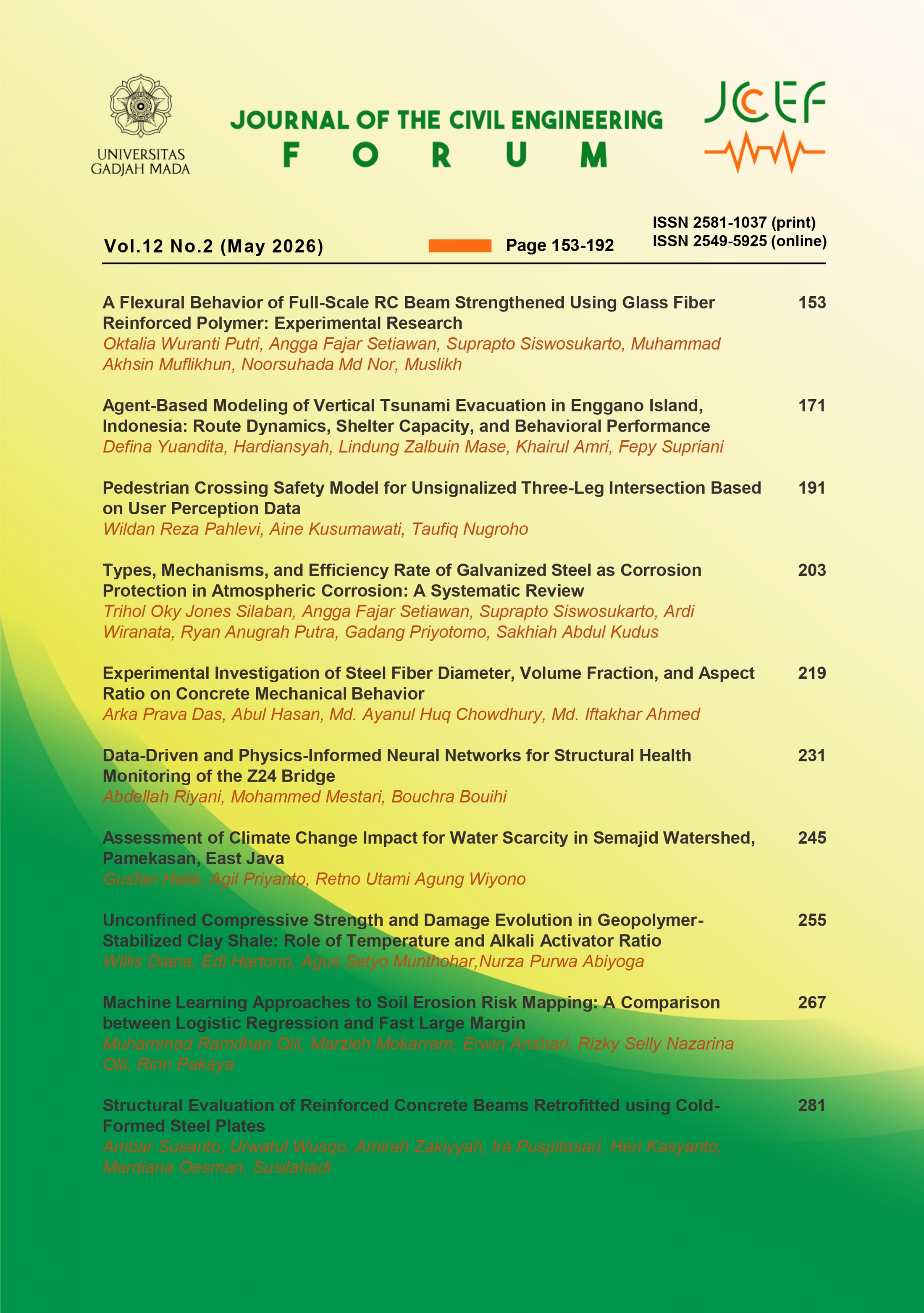
Agent-Based Modeling of Vertical Tsunami Evacuation in Enggano Island, Indonesia: Route Dynamics, Shelter Capacity, and Behavioral Performance
DOI:
https://doi.org/10.22146/jcef.24204Keywords:
disaster mitigation; agent-based modeling; tsunami vertical evacuation; shelter capacity; evacuation time; Enggano IslandAbstract
Enggano Island is situated above the southern segment of the Sunda megathrust, making it highly vulnerable to earthquake and tsunami hazards. In remote coastal villages, such as Kaana, the lack of adequate evacuation infrastructure presents significant challenges for disaster risk reduction. This study aims to evaluate tsunami evacuation strategies using an agent-based modeling approach implemented in a three-dimensional simulation environment. A purposive sampling survey involving 83 residents was conducted to collect socio-demographic data, tsunami awareness, preparedness levels, and evacuation preferences. These inputs were used to calibrate agent behavior and movement patterns to reflect realistic community dynamics in the simulation. The model simulates multiple evacuation configurations to examine survival rates and evacuation times under different spatial layouts, building distributions, and shelter capacity assumptions. Results show that horizontal evacuation via a single inland route leads to severe congestion and low survival outcomes, with only 8.2% of agents reaching safety within ten minutes. In contrast, the addition of vertical evacuation buildings significantly enhances evacuation performance, yielding survival rates above 90% under all conditions. Even when shelter capacity is limited to 70% of its full design, over 93% of agents are still able to evacuate successfully, although with increased delays. Vertical-only evacuation produces stable performance with average completion times of approximately five minutes. These findings emphasize the importance of integrating vertical shelters in strategic locations, optimizing route accessibility, and adapting building capacity to physical and demographic constraints. This study contributes to tsunami risk mitigation planning by offering empirical insights into evacuation dynamics in isolated island environments such as Enggano Island, Indonesia.
References
Amri, I., Giyarsih, S. R. and Ruslanjari, D. (2024), ‘Tsunami risk awareness, hazard warning knowledge, and intended evacuation behavior among beach users in bantul, indonesia’, International Journal of Disaster Risk Reduction 109, 104594. URL: https://doi.org/10.1016/j.ijdrr.2024.104594.
Anggraini, G. D., Mase, L. Z., Supriani, F., Misliniyati, R., Amri, K. and Chaiyaput, S. (2025), ‘Unveiling differences in seismic response: Comparative study of equivalent linear and nonlinear analyses in the central coastal region of bengkulu, indonesia’, Journal of the Civil Engineering Forum 11(1), 43–56. URL: https://doi.org/10.22146/jcef.13849.
Bonabeau, E. (2002), ‘Agent-based modeling: Methods and techniques for simulating human systems’, Proceedings of the National Academy of Sciences 99(suppl_3), 7280–7287. URL: https://doi.org/10.1073/pnas.082080899.
Chen, C., Koll, C., Wang, H. and Lindell, M. K. (2023), ‘An interdisciplinary agent-based evacuation model: integrating the natural environment, built environment, and social system for community preparedness and resilience’, Natural Hazards and Earth System Sciences 23(2), 733–749. URL: https://doi.org/10.5194/nhess-23-733-2023.
Chen, J., Wang, J., Wang, B., Liu, R. and Wang, Q. (2018), ‘An experimental study of visibility effect on evacuation speed on stairs’, Fire Safety Journal 96, 189–202. URL: https://doi.org/10.1016/j.firesaf.2017.11.010.
Choi, S., Maharjan, R., Hong, T. T. N. and Hanaoka, S. (2024), ‘Impact of information provision on tsunami evacuation behavior of residents and international tourists in japan’, Transport Policy 155, 264–273. URL: https://doi.org/10.1016/j.tranpol.2024.07.010.
Cienfuegos, R., Álvarez, G., León, J., Urrutia, A. and Castro, S. (2024), ‘Analysis of the effects of urban micro-scale vulnerabilities on tsunami evacuation using an agent-based model: Case study in the city of iquique, chile’, Natural Hazards and Earth System Sciences 24(4), 1485–1500. URL: https://doi.org/10.5194/nhess-24-1485-2024.
Dang, H. V., Lee, E., Ahn, S., Kim, K. O., Shin, S. and Ha, T. (2023), ‘Development of the global tsunami forecasting system considering the dynamic interaction of tide-tsunami around the korean peninsula’, Frontiers in Marine Science 10. URL: https://doi.org/10.3389/fmars.2023.1258552.
Fathianpour, A., Evans, B., Jelodar, M. B. and Wilkinson, S. (2023), ‘Tsunami evacuation modelling via micro-simulation model’, Progress in Disaster Science 17, 100277. URL: https://doi.org/10.1016/j.pdisas.2023.100277.
Felix, R., Hubbard, J., Wilson, K. and Switzer, A. (2024), ‘Heatmap analysis of modeled coastal tsunamis using different bathymetry data resolutions’, Geoscience Letters 11(1). URL: https://doi.org/10.1186/s40562-024-00362-6.
FEMA (2012), Assessing seismic performance of buildings with configuration irregularities: Calibrating current standards and practices, Technical report, FEMA, Washington, D.C.
Halder, A., Nordin, A., Miller, M., Kuklane, K., Nirme, J. and Gao, C. (2021), ‘Effects of leg fatigue due to exhaustive stair climbing on gait biomechanics while walking up a 10° incline: Implications for evacuation and work safety’, Fire Safety Journal 123, 103342. URL: https://doi.org/10.1016/j.firesaf.2021.103342.
Hardiansyah, Fitrianip, W., Edriani, A. F., Hardiansyah, R., Lestyanti, R. and Mase, L. Z. (2022), ‘Implementation of agent based modelling to observe the evacuating behavior at faculty of engineering building, university of bengkulu, indonesia’, Journal of the Civil Engineering Forum pp. 179–192. URL: https://doi.org/10.22146/jcef.3589.
Hardiansyah, H., Priyanto, S., Muthohar, I. and Budi Suparma, L. (2018), ‘Effect of merapi disaster evacuation on road network performance in yogyakarta special region’, International Journal of Science and Applied Technology.
Hardiansyah, Muthohar, I., Balijepalli, C. and Priyanto, S. (2020), ‘Analysing vulnerability of road network and guiding evacuees to sheltered areas: Case study of mt merapi, central java, indonesia’, Case Studies on Transport Policy 8(4), 1329–1340. URL: https://doi.org/10.1016/j.cstp.2020.09.004.
Harris, O. L., Robinson, T. R. and Wilson, T. M. (2024), ‘Agent-based modelling of evacuation scenarios for a landslide-generated tsunami in milford sound, new zealand’, International Journal of Disaster Risk Reduction 113, 104847. URL: https://doi.org/10.1016/j.ijdrr.2024.104847.
Hasegawa, N. and Takabatake, T. (2024), ‘The role of vehicular considerations in tsunami shelter location optimization’, International Journal of Disaster Risk Reduction 110, 104607. URL: https://doi.org/10.1016/j.ijdrr.2024.104607.
Heliani, L. S., Pratama, C., Wibowo, A., Sahara, D. P., Susilo, S., Wibowo, S. T., Safii, A. N., Prayoga, O., Sudrajat, A., Fuady Bisri, M. B., Kurniasari, E. D., Evelinda, S. and Setiawan Gunawan, N. G. (2025), ‘Strain accumulation in the mentawai forearc sliver, indonesia, inferred from continuous gnss-derived strain rate’, Geodesy and Geodynamics 16(1), 1–6. URL: https://doi.org/10.1016/j.geog.2024.04.003.
Hoshino, S., Sekiguchi, H., Takeuchi, R., Miyagi, K., Sato, Y., Castro, J. J., Yamamoto, K. and Kobayashi, J. (2025), ‘Feasibility and effectiveness of vertical evacuation of patients with chronic respiratory disease for tsunamis: A prospective study in a coastal area of okinawa prefecture, japan’, International Journal of Disaster Risk Reduction 116, 105161. URL: https://doi.org/10.1016/j.ijdrr.2024.105161.
Ibrahim, Syamsidik, Azmeri, Hasan, M., Irwansyah, A. and Al Farizi, M. D. (2023), ‘Assessing tsunami vertical evacuation processes based on probabilistic tsunami hazard assessment for west coast of aceh besar, indonesia’, Geoenvironmental Disasters 10(1). URL: https://doi.org/10.1186/s40677-023-00238-5.
Ito, E., Kosaka, T., Hatayama, M., Urra, L., Mas, E. and Koshimura, S. (2021), ‘Method to extract difficult-to-evacuate areas by using tsunami evacuation simulation and numerical analysis’, International Journal of Disaster Risk Reduction 64, 102486. URL: https://doi.org/10.1016/j.ijdrr.2021.102486.
Jarzyna, M. (2023), Staircase throughput study with the use of agent-based modeling, in ‘Proceedings of the International Conference on Computer-Aided Architectural Design Research in Asia’, The Association for Computer-Aided Architectural Design Research in Asia, pp. 695–704. URL: https://doi.org/10.52842/conf.caadria.2023.1.695.
Jihad, A., Muksin, U., Syamsidik, Ramli, M., Banyunegoro, V. H., Simanjuntak, A. V. H. and Rusdin, A. A. (2023), ‘Tsunami evacuation sites in the northern sumatra (indonesia) determined based on the updated tsunami numerical simulations’, Progress in Disaster Science 18, 100286. URL: https://doi.org/10.1016/j.pdisas.2023.100286.
Kim, K., Kaviari, F., Pant, P. and Yamashita, E. (2022), ‘An agent-based model of short-notice tsunami evacuation in waikiki, hawaii’, Transportation Research Part D: Transport and Environment 105, 103239. URL: https://doi.org/10.1016/j.trd.2022.103239.
León, J., Gubler, A. and Ogueda, A. (2022), ‘Modelling geographical and built-environment attributes as predictors of human vulnerability during tsunami evacuations: A multi-case-study and paths to improvement’, Natural Hazards and Earth System Sciences 22(9), 2857–2878. URL: https://doi.org/10.5194/nhess-2021-309.
Mallick, R., Meltzner, A. J., Tsang, L. L. H., Lindsey, E. O., Feng, L. and Hill, E. M. (2021), ‘Long-lived shallow slow-slip events on the sunda megathrust’, Nature Geoscience 14(5), 327–333. URL: https://doi.org/10.1038/s41561-021-00727-y.
Mas, E., Moya, L., Gonzales, E. and Koshimura, S. (2024), ‘Reinforcement learning-based tsunami evacuation guidance system’, International Journal of Disaster Risk Reduction 115, 105023. URL: https://doi.org/10.1016/j.ijdrr.2024.105023.
Mase, L. Z. (2022), ‘Local seismic hazard map based on the response spectra of stiff and very dense soils in bengkulu city, indonesia’, Geodesy and Geodynamics 13(6), 573–584. URL: https://doi.org/10.1016/j.geog.2022.05.003.
Mase, L. Z., Fathani, T. F. and Adi, A. D. (2021), ‘A simple shaking table test to measure liquefaction of prambanan area, yogyakarta, indonesia’, ASEAN Engineering Journal.
Mase, L. Z. and Likitlersuang, S. (2021), ‘Implementation of seismic ground response analysis in estimating liquefaction potential in northern thailand’, Indonesian Journal on Geoscience 8(3), 371–383. URL: https://doi.org/10.17014/ijog.8.3.371-383.
Mase, L. Z., Somantri, A. K., Chaiyaput, S., Febriansya, A. and Syahbana, A. J. (2023), ‘Analysis of ground response and potential seismic damage to sites surrounding cimandiri fault, west java, indonesia’, Natural Hazards 119(3), 1273–1313. URL: https://doi.org/10.1007/s11069-023-06157-w.
Mase, L. Z., Sugianto, N. and Refrizon (2021), ‘Seismic hazard microzonation of bengkulu city, indonesia’, Geoenvironmental Disasters 8(1). URL: https://doi.org/10.1186/s40677-021-00178-y.
Mayasari, Z. M., Astuti, M., Afandi, N. and Fauzi, Y. (2021), ‘Vertical evacuation planning to reduce a risk of a tsunami disaster in teluk segara district, bengkulu city’, Journal of Physics: Conference Series 1863(1), 012010. URL: https://doi.org/10.1088/1742-6596/1863/1/012010.
Muhammad, A., De Risi, R., De Luca, F., Kongko, W., Mori, N., Yasuda, T. and Goda, K. (2024), ‘Integrated tsunami risk framework considering agent-based evacuation modelling: The case of saga, kochi prefecture, japan’, International Journal of Disaster Risk Reduction 101, 104193. URL: https://doi.org/10.1016/j.ijdrr.2023.104193.
Muhammad, A., De Risi, R., De Luca, F., Mori, N., Yasuda, T. and Goda, K. (2021), ‘Are current tsunami evacuation approaches safe enough?’, Stochastic Environmental Research and Risk Assessment 35(4), 759–779. URL: https://doi.org/10.1007/s00477-021-02000-5.
Murao, O., Sato, M., Sugiyasu, K., Miura, H., Khoiriyah, M., Saito, R. and Affan, M. (2025), ‘Tsunami evacuation risk change associated with urban recovery in banda aceh after the 2004 aceh tsunami’, International Journal of Disaster Risk Reduction 121, 105400. URL: https://doi.org/10.1016/j.ijdrr.2025.105400.
Nakai, H., Itatani, T. and Horiike, R. (2021), ‘Construction of an evacuee placement model for tsunami shelters considering physical distancing to prevent covid-19 infection’, Progress in Disaster Science 11, 100183. URL: https://doi.org/10.1016/j.pdisas.2021.100183.
NIST (2014), Movement on stairs during building evacuations, Technical Report Technical Note 1839, NIST, Gaithersburg, MD.
Oh, W. S., Yu, D. J. and Muneepeerakul, R. (2021), ‘Efficiency–fairness trade-offs in evacuation management of urban floods: The effects of shelter capacity and zone prioritization’, PLoS ONE 16(6). URL: https://doi.org/10.1371/journal.pone.0253395.
Pan, G., Peng, M., Zhou, T., Wan, Z. and Liang, Z. (2023), ‘Research on safety design strategy of evacuation stairs in deep underground station based on human heart rate and ascending evacuation speed’, Sustainability 15(13). URL: https://doi.org/10.3390/su151310670.
Razi, P., Sumantyo, J. T. S., Chua, M. Y., Ganefri, Perissin, D. and Tadono, T. (2023), ‘Monitoring of tectonic deformation in the seismic gap of the mentawai islands using alos-1 and alos-2’, Remote Sensing Applications: Society and Environment 30, 100973. URL: https://doi.org/10.1016/j.rsase.2023.100973.
Santos, A., David, N., Perdigão, N. and Cândido, E. (2023), ‘Agent-based modeling of tsunami evacuation at figueirinha beach, setubal, portugal’, Geosciences 13(11). URL: https://doi.org/10.3390/geosciences13110327.
Somantri, A. K., Mase, L. Z., Susanto, A., Gunadi, R. and Febriansya, A. (2023), ‘Analysis of ground response of bandung region subsoils due to predicted earthquake triggered by lembang fault, west java province, indonesia’, Geotechnical and Geological Engineering 41(2), 1155–1181. URL: https://doi.org/10.1007/s10706-022-02328-x.
Triyoso, W., Kongko, W., Prasetya, G. S. and Suwondo, A. (2024), ‘Study on earthquake and tsunami hazard: Evaluating probabilistic seismic hazard function (pshf) and potential tsunami height simulation in the coastal cities of sumatra island’, Frontiers in Built Environment 10. URL: https://doi.org/10.3389/fbuil.2024.1310251.
Vivita, L., Husaini, Anggraini, R. and Dewi, C. (2023), ‘Enhancement of disaster preparedness: Approaches of place attachment and behavior to “build back better” mosque as tsunami evacuation building in Banda Aceh City, Indonesia’, Progress in Disaster Science 19, 100293. URL: https://doi.org/10.1016/j.pdisas.2023.100293.
Wang, Z. and Jia, G. (2021), ‘A novel agent-based model for tsunami evacuation simulation and risk assessment’, Natural Hazards 105(2), 2045–2071. URL: https://doi.org/10.1007/s11069-020-04389-8.
Wilensky, U. (1999), ‘Netlogo’. Center for Connected Learning and Computer-Based Modeling, Northwestern University. URL: https://ccl.northwestern.edu/netlogo/
Wood, N., Peters, J., Cheung, K. F., Yamazaki, Y., Calvo, D. and Guard, C. (2023), ‘Modeling non-structural strategies to reduce pedestrian evacuation times for mitigating local tsunami threats in Guam’, International Journal of Disaster Risk Reduction 95, 103859. URL: https://doi.org/10.1016/j.ijdrr.2023.103859.
Yamada, T. and Yamasaki, N. (2021), ‘Simulation of tsunami evacuation behavior considering inland direction’, International Journal of Disaster Risk Reduction 65, 102566. URL: https://doi.org/10.1016/j.ijdrr.2021.102566.
Yount, R. (2006), Research Design and Statistical Analysis for Christian Ministry, 4 edn, Southwestern Baptist Theological Seminary.
Yulianto, E., Rafliana, I., Febriawati, L. and Aditya, V. (2023), ‘A review of pre-disaster public awareness activities on public readiness: The 2010 Mentawai tsunami’, Natural Hazards Research 3(2), 313–325. URL: https://doi.org/10.1016/j.nhres.2023.02.001.
Zhong, G., Zhai, G. and Chen, W. (2022), ‘Optimization on spatial distribution of shelter through dynamic evacuation simulation of high-density urban area: Xinjiekou case’, KSCE Journal of Civil Engineering 26(11), 4760–4776. URL: https://doi.org/10.1007/s12205-022-0533-3.
Zhou, J., Jia, X. and Jia, J. (2020), ‘Effects of different staircase design factors on evacuation of children from kindergarten buildings analyzed via agent-based simulation’, Healthcare 8(1), 56. URL: https://doi.org/10.3390/healthcare8010056.
Zhu, K., Wang, B., Wang, J., Guo, N. and Mei, P. (2021), ‘Assessing individual evacuation performance moving on long stairs in a subway station’, Fire Technology 57(5), 2159–2179. URL: https://doi.org/10.1007/s10694-021-01114-0.
Downloads
Published
How to Cite
Issue
Section
License
Copyright is granted to authors for the purpose of providing protection for articles written to describe experiments and their results. JCEF will protect and defend the work and reputation of the author and are also willing to address any allegations of violation, plagiarism, fraud, etc. against articles written and published by JCEF. JCEF is published under the terms of the Creative Commons Attribution-ShareAlike 4.0 International License (CC BY-SA 4.0). The author holds the copyright and assigns the journal rights to the first publication (online and print) of the work simultaneously.