

AUTHOR GUIDELINES
Online Submissions
Already have a Username/Password for Berita Kedokteran Masyarakat?
GO TO LOGIN
Need a Username/Password?
GO TO REGISTRATION
Registration and login are required to submit items online and to check the status of current submissions.
Submission Preparation Checklist
As part of the submission process, authors are required to check off their submission's compliance with all of the following items, and submissions may be returned to authors that do not adhere to these guidelines.
- The submission has not been previously published, nor is it before another journal for consideration (or an explanation has been provided in Comments to the Editor).
- The submission file is in OpenOffice, Microsoft Word, RTF, or WordPerfect document file format.
- Where available, URLs for the references have been provided.
- The text uses a 9-point font Cambria; employs italics, rather than underlining (except with URL addresses); and all illustrations, figures, and tables are placed within the text at the appropriate points, rather than at the end.
- The text adheres to the stylistic and bibliographic requirements outlined in the Author Guidelines, which is found in About the Journal.
AUTHORS GUIDELINES
Berita Kedokteran Masyarakat (BKM) is a scientific journal that publishes, disseminates, and discusses scientific papers in public health. BKM is now published 12 times a year.
BKM is a peer-reviewed journal and open access journal that focuses on the fields of public health and community medicine. The topics of the article will be grouped according to the main message from the author, which includes:
- Public Health & Primary Health Care
- Community Medicine
- Occupational Health
- Environmental Health
We prioritize accepting articles that come from experience in activities in the ministry of health, health services, local government, puskesmas, and other health service facilities, non-governmental organizations, private institutions, and community residents who seek to understand public health and take actions so that the health status of the population to be better.
BKM will only accept manuscripts which fulfill the following criteria:
1. The manuscript serves the foundation for future researchers and scientists on their special public health interests.
2. The manuscript focus on both researchers and public health practitioners and policymakers in any governmental bodies, private sectors, and other social institutions.
3. The manuscript has an introduction section that reviews 10-20 articles from relevant public health fields national and/or international community medicine and/or public health journals.
4. The manuscript includes public health subjects (such as epidemiology, environmental health, occupational health, social health, health policy, public health information system, health promotion, public health nutrition, maternal and child health, or other subject areas beneficial for the improvement of public health in the workplace, community, or wider populations).
Title page
The title does not exceed 14 words written in English. The title must describe what is reported in the manuscript, not containing abbreviations or numeric numbers. The title is not a summary of results or conclusions but a description of the research topic in the manuscript. Avoid titles using the words Relationship, Analysis, and Factors. The title should not need to include the name of the research location.
Write the full name, institutional address, and email address of all authors under the title. Each name is numbered in the order of the author. Don't write a professional title or position.
Includes affiliations from all authors including name of agency department.
The name of the author for the purpose of the correspondence includes: complete address of correspondence, telephone / mobile phone, and e-mail
At the end of the title page, the number of words must be included in the abstract and manuscript.
ABSTRACT
Abstracts are a maximum of 250 words and are written in English in the form of one paragraph with the structure:
Purpose: aim of the research
Methods: research procedures, number of subjects involved, place of study, method of analysis.
Results: main results of the study
Conclusion: a brief research summary and its implications
Keywords: abstracts are accompanied by 3-5 keywords. The abstract is separated by a sign (;).
BKM follows the structure of the paper which consists of: Introduction, Methods, Results, Discussion, Conclusions, and References
INTRODUCTION
- The author must present several previous research articles that are relevant to the research theme.
- The writer must show what is lacking in the previous research so that this research is important. This "state of the art" statement can be seen in the following link: Key messages
- The introduction must explain the concepts contained in the keywords.
- The section includes a statement outlining the research rationale and study objectives, supported by relevant previous studies
- References to the introduction of at least 10 journals, preferably derived from mainly relevant international journals.
- The number of preliminary words is 400-750 words.
METHODS
- The study design should be stated at the beginning and clearly described, such as experimental, cross-sectional, qualitative, or systematic, etc.
- Don't forget to mention who is the respondent, the amount, and the selection criteria. Likewise for qualitative specifications must be explained.
- Don't forget to enter the location and time of data collection.
- Don't forget to enter the operational definition, if necessary in the form of a table.
- Ethical clearance must be provided, and all authors must confirm their roles and authorship following ICMJE guidelines
- The method ranges from 500-750 words, outside the operational definition table if there is one.
[Note to authors]: Please indicate the reporting guideline followed for this study in the Methods section. Use the guideline appropriate to the study design:
-
- SRQR (qualitative studies)
- PRISMA-ScR (scoping reviews)
Note: Registration in OSF is recommended - PRISMA-SR (systematic reviews or meta-analyses)
Note: Systematic reviews must be registered in PROSPERO and the PROSPERO registration ID must be included during journal submission. - CONSORT (randomized controlled trials)
- TREND (quasi-experimental)
- STROBE (observational studies)
Provide a brief statement in the Methods section, for example:
"This scoping review was conducted and reported in accordance with PRISMA-ScR guidelines."
RESULTS
- Table maximum 3, give important reasons if more than that.
- Results range from 750-1000 words.
- Above the table, there is a sentence: Table 1 shows blah blah blah, and so on according to the table numbering.
- We prefer the interpretation of the table rather than showing statistical significance, for example, do not mention OR = 2, but are described as follows "Working mothers are twice as likely to breastfeed as mothers who are not working"
- Note: Abbreviations and explanations should be placed below the table.
- If qualitative, all excerpts from the interview are written in correct Indonesian, it should not mention the local language as it is. Local language is only used if it reflects no Indonesian.
- In the results there can be no references, all references are in the introduction and discussion.
- The figure was created in JPEG format at HD resolution or in Google Drawing format, so the information remains clearly readable. Figures must be clear and legible in both print and online versions. The following technical requirements should be met:
Photographs and image-based figures: minimum 600 dpi,
Graphs, diagrams, and line art: minimum 1000 dpi
Accepted formats: JPEG, PNG, and vector formats (PDF/EPS)
DISCUSSIONS
- Discuss important findings that can be used to propose recommendations or that have implications for real public health programs in the 2-3 paragraphs.
- Discuss references that are relevant to program implications. This "social issue impact" statement can be seen in the following link: Implications statement in one paragraph.
- Additional discussion regarding future research implications could be added in a single paragraph.
- Discuss the study limitations relevant to the conclusions in one paragraph.
- Length of discussion 750-1000 words.
- We remind that the discussion does not repeat the results, let alone mention statistical figures.
CONCLUSIONS
Conclusions consist of 1-2 paragraphs, containing important points to be highlighted and important points highlighted as program implications.
The number of concluding words ranges from 150-250 words.
Acknowledgments
This section acknowledges individuals, institutions, or organizations that contributed to the research but do not meet the criteria for authorship.
Authors’ contribution
Author contributions follow the CRediT (Contributor Roles Taxonomy, NISO: https://credit.niso.org).
Funding
List financial support and grant numbers.
Data availability
Indicates whether the data supporting the findings are available, either in a public repository or upon reasonable request from the corresponding author.
Ethics statement
Confirm ethical approval and informed consent.
Conflicts of interest
Declares whether authors have any financial or personal conflicts that could influence the results, or explicitly states that none exist.
Use of artificial intelligence (AI)
The use of AI is not encouraged. If used, authors must disclose the tool name, purpose, sections used, and confirm review. Authors remain fully responsible for accuracy, originality, and integrity, and AI must not be used for core analysis, interpretation, or misrepresentation.
REFERENCES
References generally have two emphasizes. The first emphasis, references that indicate previous studies which are the reasons why this research is needed, are more or less 10-15 references. The second emphasis, on references that are relevant to the issue points in the discussion, is more or less 10-15 references. We expect the authors to also refer to 1-3 references used in the method or data collection, if there is a specific analysis strategy.
Reference should be in the form of the latest journal in the last 10-15 years. Although it is permissible to do so, quotations in textbooks, regulations, or theses should be minimized.
Reference wherever possible refers to journals of specific fields that are the author's expertise. For example, if the researcher is an epidemiologist then the journal is more about epidemiology, if the manuscript is related to hospital management, then the reference is to prioritize health and hospital services.
- The number of references should be a minimum of 15 or more
- If your references use a website link/address, please use the insert link feature to link the word to the website. Write only the main address of your reference and insert a complete link using the insert link feature.
- If available, you should write a digital object identifier (DOI) in the journal name without abbreviation using the insert link feature.
- If a DOI link is unavailable, omit it, and do not abbreviate the journal name or underline it.
- Please double-check the citation order to align it with the reference list. Use numerical or Vancouver-style citations, with square brackets “[...]”, where author names are not necessary.
- Please write the authors’ names with the last name first, followed by the initials of the first name, listing a maximum of 6 (six) authors. If there are more than 6 (six) authors, use “et al.” after the sixth author
Examples:
(Journals)
Subadi S. The Indonesian government’s regulation on the management of COVID-19 hazardous medical waste from health service facilities and self-isolation activities. Open Access Macedonian Journal of Medical Science. 2022;10: 1637–41.
Kaur RJ, Dutta S, Bhardwaj P, Charan J, Dhingra S, Mitra P, et al. Adverse events reported from COVID-19 vaccine trials: a systematic review. Indian Journal of Clinical Biochemistry. 2021;36:427–39.
(Online articles)
Baumgartner FR. John Kingdon and the evolutionary approach to public policy and agenda setting. Handbook of public policy agenda setting. 2016. Available from: [Website]
World Health Organization. WHO child growth standards: length/height-for-age, weight-for-age, weight-for-length, weight-for-height and body mass index-for-age; methods and development. Geneva: WHO Press; 2006. Available from: [Website]
(Masters' theses or doctoral dissertations)
Haslem EB, Bailey E. The relationship between health-related fitness knowledge, perceived competence, self-determination, and physical activity behaviors of high school students [Thesis]. Provo: Brigham Young University; 2014. Available from: [Website]
(Books)
Notoatmodjo S. Ilmu perilaku kesehatan. Jakarta: Rineka Cipta; 2014.
Writing Technique
Text is typed in Droid serif 9 font, spacing 1.3, on A4 size paper, 2 columns (according to template)
The maximum number of words in the body of the manuscript is 3500 words (main body) for research articles, 4000 words (main body) for review
For qualitative research, the maximum is 4000 words (main body)
Writing abbreviations without explanation is only for units of measurement, in addition, it must mention the length when the abbreviation is first written.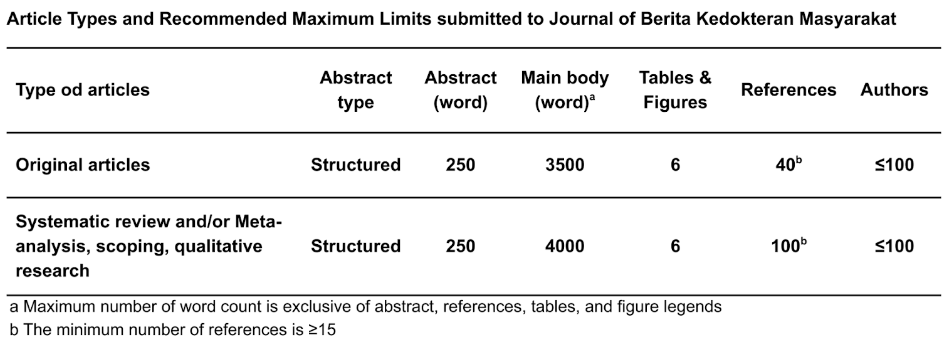
Language
The language used is standard English with American English spelling.
Writing abstracts in English must follow good and correct English grammar.
The use of foreign terms is marked with italics.
Tables and Figures
The table must be given a title above the table with the Droid serif 9. font. The table must be independently understandable. The bottom of the table should contain information that explains the symbols or abbreviations used in the table.
The maximum number of tables is 3 tables. The table is not from a screen capture (image).
The image is titled under the image.
The author is required to follow the flow and conditions in the Editor's Journal of Community Medicine News.
The maximum number of figures is 3 figures.
The figure was created in JPEG format at HD resolution or in Google Drawing format, so the information remains clearly readable. Figures must be clear and legible in both print and online versions. The following technical requirements should be met: Photographs and image-based figures: minimum 600 dpi, Graphs, diagrams, and line art: minimum 1000 dpi, accepted formats: JPEG, PNG, and vector formats (PDF/EPS).


