Vol 20 No 1 (2026): March

ISSN Online : 2477-3751

ISSN Print : 0126-4451

Publisher
Universitas Gadjah Mada

About Journal

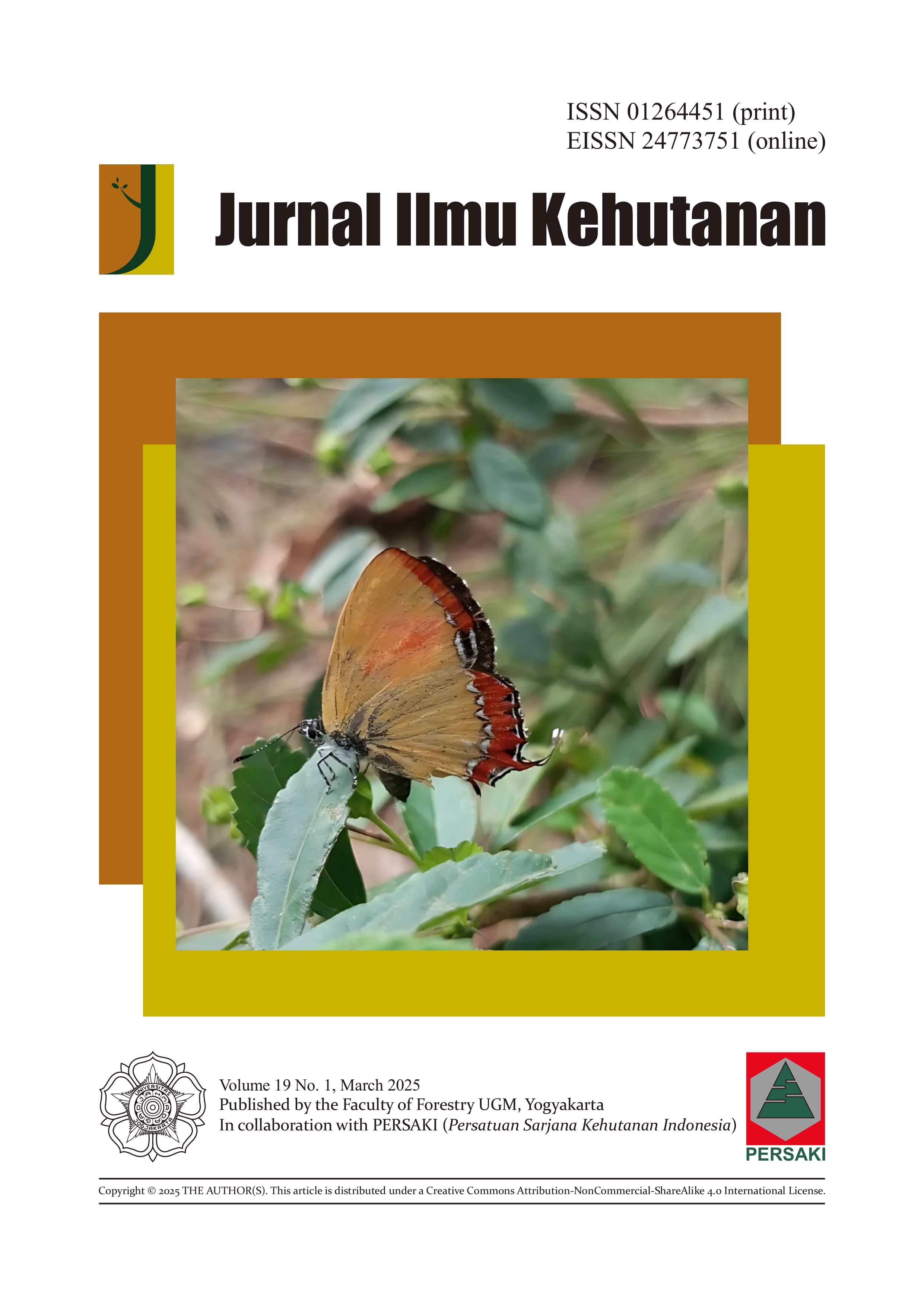
Jurnal Ilmu Kehutanan (JIK) is a biannual open access journal by the Faculty of Forestry, Universitas Gadjah Mada, Indonesia, in cooperation with Indonesia Forestry Scholar Association (PERSAKI). JIK publishes peer-reviewed scientific articles focusing on aspects of tropical forestry and environments, both basic and applied covering topics on forest management, silviculture, biodiversity conservation, forest products technology. Additionally, the journal emphasizes the importance of climate change adaptation and mitigation strategies in promoting sustainable development practices that protect and enhance forest ecosystems. The Journal intended as a medium for communicating and motivating research activities through scientific papers, including research papers, short communications, and reviews written in English. Jurnal Ilmu Kehutanan (printed version) is accredited Sinta 2 by the Directorate General of Research and Development, Ministry of Higher Education, Science, and Technology No. 10/C/C3/DT.05.00/2025, valid from Vol. 18 No. 1 (2024) until Vol. 22 No. 2 (2028).

All publications are available online. In 2021 the journal migrated to this improved website to allow comprehensive online submission processes. Therefore, the publications have two access links as follows.

Articles of Vol 1 - Vol 14 (2007-2020) can be accessed from our old website: https://jurnal.ugm.ac.id/jikfkt
Articles of Vol 15 - present (2021-present) can be accessed from this website: https://jurnal.ugm.ac.id/v3/jik


JIK Updates!

How picky are stingless bees about their food?

Riendriasari & Rahayu (2022) analyzed pollen from stingless bee hives placed in three land-use types: agroecosystems, forests, and settlements. The researchers found four stingless bee species: Heterotrigona erythrogastra, Tetragonula clypearis, T. fuscobalteata, and T. laeviceps, more..


The Importance of Fresh Mycorrhizal Inoculants

Istiqomah et al. (2025) investigated how storage duration affects the quality and effectiveness of mycorrhizal inoculants used in agriculture. The researchers compared inoculants stored for less than one year with those stored for twenty years, using sorghum plants as a model. more..


Turning Fire News into Fire Prevention

Forest and land fires remain one of Indonesia’s most pressing environmental disasters, with major impacts on health, biodiversity, economy, and climate. Kumalawati et al. (2022) analyzed how online media framed the causes of forest and land fires in South Kalimantan and what this means for future disaster mitigation. more..


Nugal: Indigenous Farming for Forest Conservation

Mirza (2025) reveals that Nugal, a traditional farming practice on the Dayak Kuhin community in Central Kalimantan, embodies strong forest conservation values. Guided by local knowledge and customary rules, Nugal challenges the stigma that indigenous agriculture causes forest degradation. more..

Announcements

Mapping a Future for Sumatran Elephants

Feb 21, 2026

Dok_Balai_TN_Way_Kambas_new.png

A new article from Jurnal Ilmu Kehutanan has pinpointed exactly why human-elephant conflict is rising and how to fix it.

Subeno et al. (2025) used satellite mapping (GIS) to analyze the Rawa Bunder area. The researchers checked for food, water, and forest cover to see where elephants can actually survive.

How is social forestry implemented beyond policy documents?

Feb 11, 2026

wanagama3_seputargk_id.jpg

Permadi et al. (2022) highlight the critical role of local forest bureaucrats in interpreting Indonesia’s Social Forestry policy. Rather than prioritizing licensing-based schemes, local actors tend to favor forestry partnerships and environmental services, particularly ecotourism.

Improving the Survival of Medicinal Plants in Dry Landscapes

Jan 23, 2026

IG_boyolali_jateng_upscayl_2x_upscayl-lite-4x.png

Bidara Laut (Strychnos lucida R.Br.) is a valuable medicinal plant from West Nusa Tenggara, traditionally used to treat malaria, diabetes, and hypertension. However, its cultivation is challenging under dry and hot conditions such as those found in the Mount Tunak Natural Tourism Park (TWA)

Indexed In

Information

We encourage readers to sign up for the publishing notification service for this journal. Use the journal's Register link at the top of the home page. This registration will result in the reader receiving the Table of Contents by email for each new issue of the journal. This list also allows the journal to claim a certain level of support or readership. See the journal's Privacy Statement, which assures readers that their name and email address will not be used for other purposes.

Need help with registering under the platform of open journal system (OJS) version 3.1? Please visit this.

Are you interested in submitting to this journal? Please review the About the Journal page for the journal's section policies and the Author Guidelines. Authors must register with the journal before submitting or, if already registered, can log in and begin the five-step process. The manuscript template is available here. A tutorial for submission adopted from BPP UGM (2021) is available here.

Need help registering and authoring under the open journal system (OJS) version 3.1? Please visit this link for its user guide.

We encourage research librarians to list this journal among their library's electronic journal holdings. It is also worth noting that this journal's open source publishing system is suitable for libraries to host for their faculty members to use with journals they are involved in editing (see Open Journal Systems).